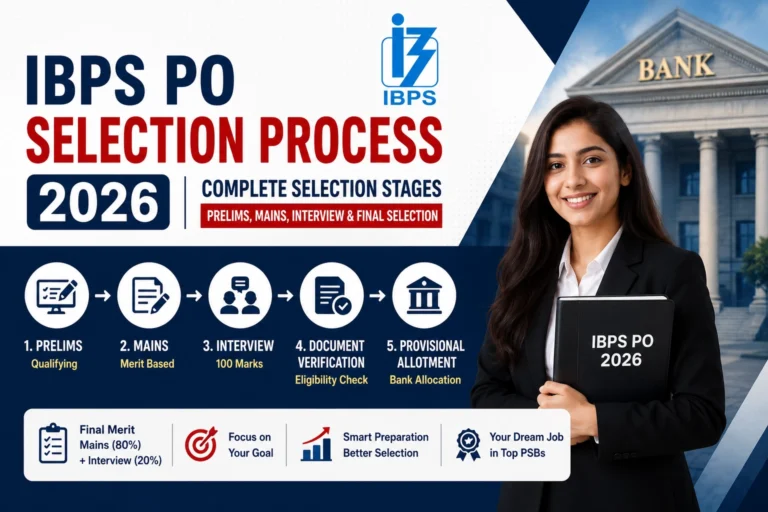
How to Crack IBPS PO 2026 in First Attempt: Simple Strategy
Quick Overview
Practice free quizzes, mock tests, current affairs and exam-wise preparation resources on ExamTune.
IBPS PO Preparation Strategy PDF
Download this IBPS PO preparation strategy PDF for a quick revision of the study plan, subject-wise preparation tips, mock test strategy, and important exam guidance.
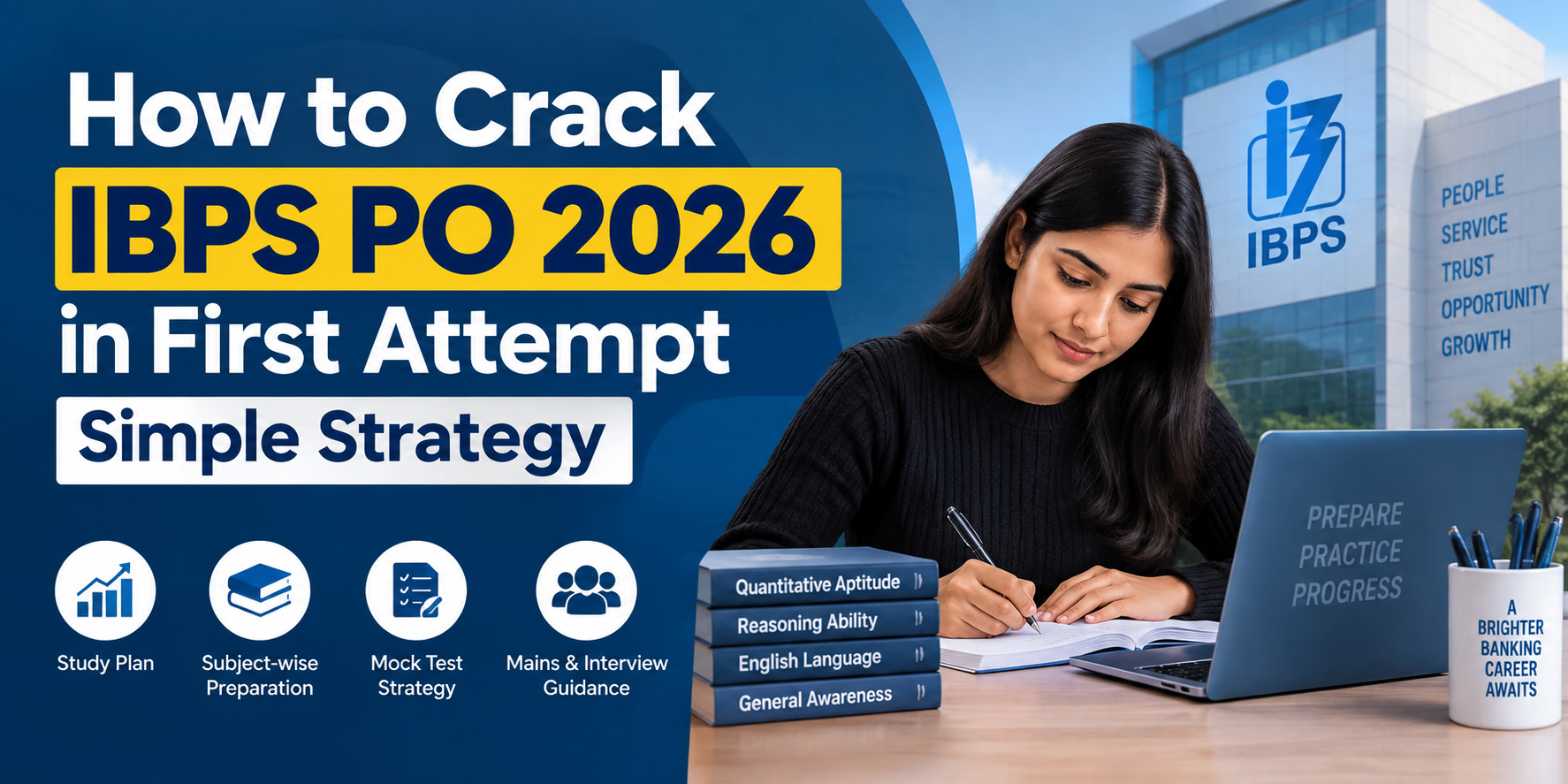
If you want to know how to crack IBPS PO in first attempt, the answer is not studying for the maximum number of hours. The smarter approach is to understand the latest IBPS PO pattern, build strong concepts, practise questions under sectional time limits, analyse mock tests, revise regularly and prepare for the Main Examination well before the Prelims result.
For the current IBPS PO 2026 CRP PO/MT-XVI recruitment cycle, this approach is even more important. The Preliminary Examination was conducted on 22 and 23 August 2026, while the Main Examination is scheduled for 4 October 2026. As of 9 September 2026, candidates are waiting for the Prelims result and should use this period for serious Mains preparation instead of pausing their studies.
A successful IBPS PO preparation strategy should combine Quantitative Aptitude, Reasoning, English, General/Economy/Banking Awareness, Digital and Financial Awareness, RBI-related updates, Data Analysis & Interpretation, descriptive preparation, mock analysis and revision into one structured plan.
⚡ IBPS PO 2026 Latest Update – 09 September 2026
The IBPS PO 2026 application process is closed. The Preliminary Examination has already been conducted on 22–23 August 2026. The latest updated indicative vacancy figure is 7,565 as per the vacancy revision dated 27 August 2026. The IBPS PO Main Examination is scheduled for 4 October 2026. Candidates who appeared in Prelims should continue Mains preparation without waiting for the result.
IBPS PO 2026 Current Status: What Should Candidates Do Now?
Before following any IBPS PO exam preparation plan, candidates should understand the current stage of the recruitment process. A preparation article that still tells candidates to prepare for August Prelims is no longer sufficient after the examination has been conducted.
| Particular | Current IBPS PO 2026 Status |
|---|---|
| Exam | IBPS Probationary Officer / Management Trainee |
| Recruitment Cycle | CRP PO/MT-XVI |
| Application Status | Closed |
| Updated Indicative Vacancies | 7,565 |
| Prelims Exam | 22 & 23 August 2026 – Conducted |
| Prelims Result | Awaited as of 09 September 2026 |
| Mains Exam | 4 October 2026 |
| Further Stages | Personality Test + Common Interview |
| Official Source | IBPS – CRP PO/MT-XVI |
Can IBPS PO Be Cracked in the First Attempt?
Yes, IBPS PO can be cracked in the first attempt. The examination does not give any advantage simply because someone has attempted it before. A first-time candidate who understands the examination, follows a structured IBPS PO first attempt strategy and continuously improves through mocks can outperform a repeat aspirant following an unplanned approach.
First-attempt selection becomes realistic when candidates work on five areas together:
- Concepts: Understand the method before chasing speed.
- Practice: Solve examination-relevant questions every day.
- Testing: Take sectional and full-length mocks.
- Analysis: Correct recurring mistakes and poor question selection.
- Revision: Revisit formulas, concepts, vocabulary and current affairs repeatedly.
The most useful IBPS PO exam strategy is therefore:
Latest IBPS PO Exam Pattern You Must Prepare For
Knowing the latest pattern is an essential part of your IBPS PO preparation strategy. The CRP PO/MT-XVI pattern has important changes, so candidates should avoid relying only on old preparation material.
IBPS PO Prelims Exam Pattern
| Section | Questions | Maximum Marks | Time |
|---|---|---|---|
| English Language | 30 | 30 | 20 Minutes |
| Quantitative Aptitude | 35 | 30 | 20 Minutes |
| Reasoning Ability | 35 | 40 | 20 Minutes |
| Total | 100 | 100 | 60 Minutes |
One important feature of the revised Prelims pattern is that Reasoning carries 40 marks for 35 questions, while Quantitative Aptitude carries 30 marks for 35 questions. Therefore, candidates should not assume that every question necessarily carries the same marks.
IBPS PO Mains Exam Pattern 2026
| Section | Questions | Maximum Marks | Time |
|---|---|---|---|
| Reasoning | 40 | 60 | 45 Minutes |
| English Language | 40 | 20 | 35 Minutes |
| Data Analysis & Interpretation | 40 | 60 | 45 Minutes |
| General / Economy / Banking Awareness / Digital / Financial Awareness including RBI Circulars | 50 | 60 | 35 Minutes |
| Objective Test Total | 170 | 200 | 160 Minutes |
| Descriptive Paper – Essay & Comprehension | 2 | 25 | 30 Minutes |
There is negative marking in objective examinations. For an incorrect answer, one-fourth of the marks assigned to that question is deducted. An unanswered question does not attract this penalty. This makes accuracy an essential part of every IBPS PO exam strategy
Best IBPS PO First Attempt Strategy: The 70-20-10 Execution Formula
A practical way to organise your IBPS PO study plan is to divide preparation according to the work that actually improves scores.
| Share of Preparation | Focus | What It Includes |
|---|---|---|
| 70% | Question Practice | Topic practice, timed sets, sectional tests, full mocks and previous-paper style questions. |
| 20% | Analysis & Correction | Error log, mock review, weak-topic correction and re-solving difficult questions. |
| 10% | Theory & Notes | Concept revision, formulas, grammar rules, banking notes and current-affairs consolidation. |
This is not an IBPS rule; it is a preparation framework. Beginners may initially spend more time on concepts and gradually move towards practice and testing.
IBPS PO First Attempt Success Roadmap
| Stage | Primary Goal | What to Do |
|---|---|---|
| Stage 1 | Concept Clarity | Finish important basics of Quant, Reasoning and English. |
| Stage 2 | Accuracy | Complete topic-wise practice before increasing speed. |
| Stage 3 | Speed | Use timers, sectional tests and short mixed quizzes. |
| Stage 4 | Mains Depth | Add advanced DI, difficult puzzles, GA, banking and descriptive preparation. |
| Stage 5 | Exam Temperament | Attempt full-length mocks in examination-like conditions. |
| Stage 6 | Performance Improvement | Analyse mocks, repair weak topics and retest them. |
| Stage 7 | Final Revision | Revise high-value notes rather than collecting new material. |
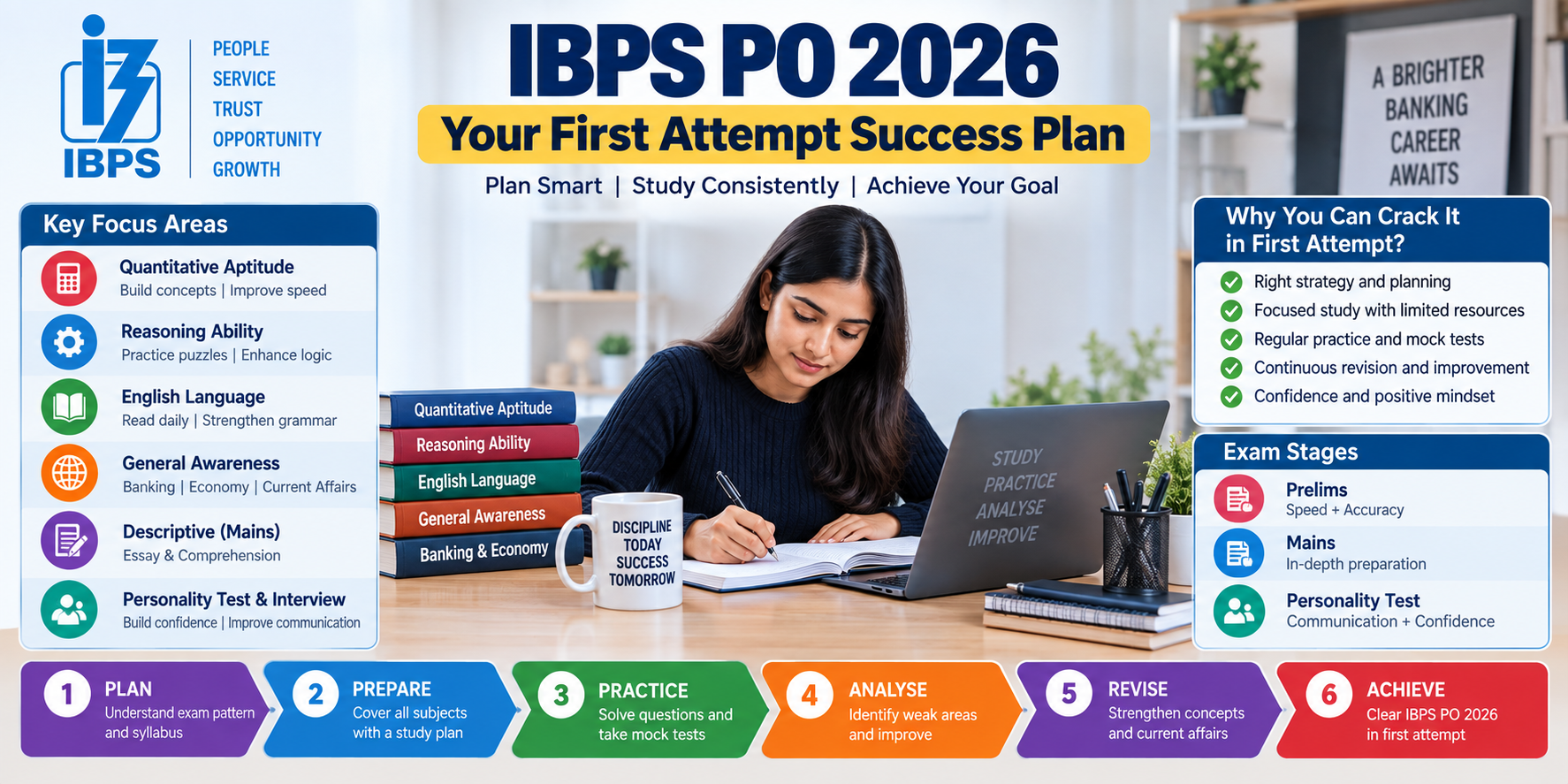
IBPS PO Prelims Strategy for First Attempt
A strong IBPS PO Prelims strategy is built around speed, accuracy and question selection. Prelims should be treated as a screening stage, but candidates still need to clear the prescribed cut-offs.
1. Build Sectional Speed
Since English, Quantitative Aptitude and Reasoning each have a separate 20-minute timer, preparation should include timed sectional practice from an early stage.
2. Do Not Chase Maximum Attempts
There is no universal number of “safe attempts” applicable to every shift. Difficulty, candidate performance and cut-offs can vary. Attempt questions that you can solve with reasonable confidence rather than increasing attempts through guesswork.
3. Develop a Question-Selection System
During practice, classify questions into:
- Immediate: Can be solved quickly and accurately.
- Manageable: Requires some work but is worth attempting.
- Low Return: Too lengthy or uncertain for the available time.
This selection ability becomes especially valuable in Puzzles and Data Interpretation.
IBPS PO Mains Strategy for First Attempt
A good IBPS PO Mains strategy cannot begin after the Prelims result. Mains requires advanced problem-solving, awareness revision and descriptive preparation that cannot be developed effectively in a few days.
For candidates appearing in the current cycle, the IBPS PO Mains preparation strategy should now receive maximum priority because the Main Examination is scheduled for 4 October 2026.
Mains Priority Order
Priority 1: General, Economy, Banking, Digital and Financial Awareness including RBI developments.
Priority 2: Mains-level Reasoning and complex Puzzles.
Priority 3: Data Analysis & Interpretation with strong Arithmetic.
Priority 4: Reading-based and application-oriented English.
Priority 5: Essay and Comprehension practice under typing constraints.
25-Day IBPS PO Mains Preparation Strategy From 9 September
With approximately 25 days between 9 September and 4 October 2026, current candidates need an intensive but controlled plan.
| Days | Main Objective | Action Plan |
|---|---|---|
| Days 1–5 | Diagnosis + Revision | Take one serious Mains mock, identify weak areas, revise Arithmetic, Puzzle frameworks, English fundamentals and current-affairs backlog. |
| Days 6–10 | High-Level Practice | Daily Mains DI, complex Reasoning, Reading Comprehension, GA revision and descriptive practice. |
| Days 11–15 | Integration | Alternate full mocks with section-focused repair sessions. Start rapid monthly current-affairs revision. |
| Days 16–20 | Mock Intensive Phase | Attempt Mains mocks regularly, review time distribution and rebuild sections where accuracy falls. |
| Days 21–23 | Consolidation | Revise error notebook, important RBI/banking points, formulas and frequently repeated mistakes. |
| Days 24–25 | Final Stabilisation | Light revision, selected questions and short notes. Avoid exhausting yourself with excessive new material. |
IBPS PO Subject Wise Preparation Strategy
A balanced IBPS PO subject wise preparation approach prevents one strong subject from hiding weaknesses in another.
| Section | High-Priority Areas | Preparation Approach |
|---|---|---|
| Quantitative Aptitude / DAI | Arithmetic, calculations, Data Interpretation and data-based application | Build arithmetic strength, improve calculations and practise timed DI sets. |
| Reasoning | Puzzles, Seating Arrangements, Logical Reasoning and other recurring formats | Practise different structures and learn when to leave an unproductive set. |
| English | Reading Comprehension, grammar application, vocabulary and verbal ability | Combine daily reading with timed question practice and detailed error analysis. |
| General / Economy / Banking Awareness | Current Affairs, Banking, RBI, financial and economic developments | Study continuously and use multiple revision cycles instead of one-time reading. |
| Descriptive | Essay and Comprehension | Practise typing, structure, grammar, clarity and concise expression. |
IBPS PO Quantitative Aptitude Strategy
The core of a reliable IBPS PO quantitative aptitude strategy is strong Arithmetic plus efficient calculations.
- Strengthen Percentage, Ratio, Average, Profit & Loss, SI-CI, Time & Work, Time-Speed-Distance and related Arithmetic concepts.
- Revise useful fraction-percentage conversions.
- Improve multiplication, squares and approximation skills.
- Practise questions under a timer after learning the concept.
- For Mains, practise different Data Interpretation formats rather than repeating only one type.
- Maintain a list of calculation mistakes and conceptual errors.
Do not memorise shortcuts without understanding why they work. A shortcut that you cannot reproduce under pressure is not a dependable examination technique.
IBPS PO Reasoning Strategy
An effective IBPS PO reasoning strategy requires regular exposure to different logical structures.
- Practise Puzzles and Seating Arrangements consistently.
- Move from single-variable to multi-variable arrangements gradually.
- Re-solve difficult sets after checking the solution.
- Track how long each puzzle takes.
- During mocks, scan the conditions before committing to a set.
- Mix puzzles with standalone reasoning questions.
The objective is not to solve every puzzle. The objective is to recognise which puzzles can be converted into marks within the available time.
IBPS PO English Strategy
A strong IBPS PO English strategy should focus on comprehension and application instead of isolated memorisation.
- Read quality English content daily.
- Practise one Reading Comprehension set regularly.
- Revise grammar through questions rather than rules alone.
- Learn vocabulary in sentences and context.
- Maintain an error list for grammar and vocabulary.
- For Mains, practise longer and inference-based passages.
Regular reading also supports descriptive preparation and improves understanding of banking and economic issues.
IBPS PO Banking Awareness Strategy
Your IBPS PO banking awareness strategy should combine current affairs with banking and financial concepts.
Priority areas include Banking Awareness, RBI developments, monetary and financial-sector updates, Digital Banking, government schemes, economic developments, important reports, appointments and major national/international events relevant to the examination.
A practical IBPS PO current affairs preparation approach is to study daily and revise weekly and monthly. Many aspirants read current affairs but fail to retain them because they do not revisit the material.
IBPS PO Descriptive Paper Preparation
The latest IBPS PO descriptive paper preparation must match the revised 2026 format. Candidates should prepare for Essay and Comprehension, not blindly follow old material based on Letter Writing.
For Essay practice:
- Write a clear introduction.
- Use logically connected body paragraphs.
- Support points with balanced reasoning.
- Avoid unnecessary repetition.
- Finish with a concise conclusion.
- Check grammar and sentence clarity.
For Comprehension, practise identifying the central idea, factual details, inference and context while writing concise answers.
Since the examination is computer-based, typing practice should also be included in your IBPS PO exam preparation.
IBPS PO Daily Study Plan
The best IBPS PO daily study plan depends on whether you are a full-time student or managing preparation with a job or college. There is no official requirement to study a fixed number of hours.
Daily Plan for Full-Time Aspirants
| Study Block | Suggested Focus |
|---|---|
| Block 1 | Quantitative Aptitude / Data Interpretation |
| Block 2 | Reasoning / Puzzles |
| Block 3 | English + Reading Comprehension |
| Block 4 | Current Affairs + Banking Awareness |
| Block 5 | Mock / Sectional Test + Analysis |
| Final Revision | Error notebook + formulas + GA revision |
Daily Plan for Working Candidates
Working aspirants can use shorter study blocks:
- Morning: Quant or Reasoning.
- Commute / Break: Current-affairs revision where practical.
- Evening: Second aptitude section.
- Night: English or Banking Awareness.
- Weekend: Full-length mocks, deep analysis and backlog correction.
For working candidates, consistency across the week matters more than one extremely long weekend session.
90-Day IBPS PO Study Plan for Future Aspirants
Although the current 2026 cycle has already reached the post-Prelims phase, this article should remain useful for aspirants starting early. A 90-day IBPS PO study plan can be organised as follows:
| Period | Focus |
|---|---|
| Days 1–30 | Concept building, topic practice, basic sectional tests and daily GA. |
| Days 31–60 | Higher-level practice, Mains DI/Reasoning, sectional mocks and weekly full mocks. |
| Days 61–75 | Full mocks, current-affairs consolidation and descriptive practice. |
| Days 76–90 | Revision, mock analysis, weak-topic correction and exam temperament. |
IBPS PO Mock Test Strategy
The difference between attempting mocks and using mocks effectively is analysis. A good IBPS PO mock test strategy treats every mock as a diagnostic tool.
Track These 7 Metrics After Every Mock
| Metric | What It Tells You |
|---|---|
| Attempts | How much of the paper you could reach. |
| Accuracy | Whether attempts are actually converting into marks. |
| Section Score | Your relative strength across sections. |
| Time Spent | Where excessive time is being consumed. |
| Easy Questions Missed | Whether question selection is weak. |
| Wrong Questions | Conceptual, calculation or judgement errors. |
| Score Trend | Whether performance is improving across multiple mocks. |
Use an Error Log
For every important error, record:
Topic → Error Type → Why It Happened → Correct Method → Re-test Date
Typical error types include concept gap, calculation mistake, careless reading, excessive time investment and incorrect question selection.
For additional shift and pattern insights, candidates can refer to the IBPS PO Exam Analysis.
How Many IBPS PO Mock Tests Should You Attempt?
There is no official number of mocks that guarantees selection. Beginners should first build concepts and take sectional tests. Full-length mock frequency should increase as preparation becomes stronger.
A candidate who attempts fewer mocks but analyses every question carefully may improve more than someone who attempts dozens of mocks without reviewing mistakes.
The correct sequence is:
How to Use Previous Year Questions for IBPS PO
Previous examination questions and memory-based papers are useful for understanding recurring question formats, difficulty and time requirements.
However, previous papers should be used to understand trends rather than predict that the exact same topic distribution will appear again.
Use previous questions in three stages:
- Topic-wise practice during concept building.
- Timed sectional practice during speed improvement.
- Full-paper practice before the examination.
IBPS PO Revision Strategy
A strong IBPS PO revision strategy prevents preparation from becoming a continuous cycle of learning and forgetting.
Maintain Four Short Revision Resources
- Formula Book: Quant formulas, fractions and useful calculation notes.
- Error Book: Repeated mistakes from practice and mocks.
- English Book: Grammar errors, vocabulary and confusing usage.
- GA Notes: High-value Banking, RBI, financial and current-affairs facts.
Use spaced revision. A topic should be revisited after learning rather than waiting until the final week.
Weekly Performance Scoreboard for First-Attempt Aspirants
Instead of judging yourself only by hours studied, track performance every week.
| Parameter | Track Weekly |
|---|---|
| Mock Scores | Improving / Stable / Falling |
| Accuracy | Section-wise percentage |
| Weak Topics | Maximum 2–3 priority repair areas |
| Calculation Speed | Quant and DI improvement |
| Puzzle Time | Average time for manageable sets |
| GA Revision | Backlog vs completed revision |
| Descriptive Practice | Completed / pending |
This turns your IBPS PO preparation tips into measurable action instead of vague motivation.
Top Habits That Improve First-Attempt Selection Chances
- Start preparation with the latest pattern.
- Keep study resources limited.
- Practise every day instead of studying theory continuously.
- Prepare Mains topics before Prelims is over.
- Maintain an error notebook.
- Analyse mocks seriously.
- Revise current affairs repeatedly.
- Track accuracy rather than attempts alone.
- Work on one or two major weaknesses at a time.
- Do not change strategy simply because of one bad mock.
IBPS PO Personality Test Preparation
The IBPS PO Personality Test is an important part of the recruitment process after the Main Examination for shortlisted candidates.
Preparation should focus on self-awareness, communication, judgement, professional behaviour and banking-sector understanding rather than memorising artificial responses.
Candidates should remain aware of official IBPS instructions because the exact schedule and mode will be communicated by IBPS to shortlisted candidates.
IBPS PO Interview Preparation
Good IBPS PO interview preparation starts well before the interview call letter. Candidates should gradually prepare their profile and banking knowledge after the Main Examination.
Prepare these areas:
- Your education and graduation subject.
- Your hometown, district and state.
- Work experience, if applicable.
- Why you want to join banking.
- Why you want to become a Probationary Officer.
- Basic banking concepts.
- RBI and monetary-policy concepts.
- Recent banking and economic developments.
- Government financial schemes.
- Your strengths, weaknesses and career decisions.
Answers should sound natural and factual. If you do not know something during an interview, an honest response is usually better than guessing confidently.
For a dedicated guide, read IBPS PO Interview 2026.
Common Mistakes That Can Ruin an IBPS PO First Attempt
| Mistake | Better Approach |
|---|---|
| Preparing only for Prelims | Build Mains GA, DI, advanced Reasoning and descriptive skills alongside Prelims. |
| Collecting too many resources | Select limited reliable sources and revise repeatedly. |
| Attempting mocks without analysis | Spend serious time reviewing every important error. |
| Focusing only on speed | Improve accuracy first, then speed. |
| Ignoring weak topics | Maintain a weekly weakness-repair plan. |
| Reading GA without revision | Use daily, weekly and monthly revision cycles. |
| Using outdated pattern material | Prepare according to CRP PO/MT-XVI. |
| Using old descriptive format | Prepare Essay and Comprehension for the current cycle. |
| Comparing mock scores blindly | Track your own score and accuracy trend. |
| Waiting for the Prelims result | Begin Mains preparation immediately after Prelims. |
Is Coaching Necessary to Crack IBPS PO in First Attempt?
No preparation method can guarantee selection. Some candidates successfully prepare through self-study, while others prefer structured classes, organised study material, doubt support and test series.
Regardless of the method, the fundamentals remain the same: concept clarity, question practice, mock analysis, current-affairs revision and consistent execution.
How Many Hours Should You Study for IBPS PO?
There is no official number of hours required to clear IBPS PO. A student studying five hours with focused practice and analysis can gain more than someone spending eight hours switching randomly between resources.
Measure preparation through completed targets such as:
- Topics mastered.
- Questions solved accurately.
- Mocks analysed.
- Weak areas repaired.
- Current-affairs revisions completed.
Quality × Consistency is more valuable than raw study hours.
IBPS PO Preparation Resources: What You Actually Need
A focused resource stack is usually enough for effective preparation:
- One reliable concept source for every major subject.
- Topic-wise practice questions.
- Sectional tests.
- A current-pattern full mock-test series.
- Previous-year or memory-based questions.
- One dependable current-affairs source.
- Short self-made revision notes.
Avoid changing your entire source simply because one mock score was disappointing.
Final 10-Point Checklist to Crack IBPS PO in First Attempt
- Understand the latest CRP PO/MT-XVI pattern.
- Build concepts before chasing speed.
- Prepare Prelims and Mains in an integrated manner.
- Practise Quant, Reasoning and English consistently.
- Study Banking and Current Affairs throughout preparation.
- Attempt sectional and full-length tests.
- Analyse every serious mock.
- Maintain and revise an error log.
- Revise high-value content repeatedly.
- Prepare according to the current recruitment stage, not an outdated timetable.
Final Strategy: How to Crack IBPS PO in First Attempt
The most reliable answer to how to crack IBPS PO in first attempt is to stop looking for a single shortcut. Selection requires a repeatable system based on concepts, accurate practice, timed tests, analysis and revision.
For candidates appearing in IBPS PO 2026, the situation is now very specific. Prelims has already been conducted and Mains is scheduled for 4 October 2026. Therefore, your current IBPS PO Mains preparation strategy should prioritise Mains-level Reasoning, Data Analysis & Interpretation, General/Economy/Banking Awareness, RBI and financial updates, English, Essay and Comprehension, along with full-length mock tests.
Do not measure your chances by one mock score or by how many hours another candidate studies. Measure improvement through accuracy, mock trends, weak-topic reduction and revision quality.
The First-Attempt Formula
Strong Basics + Smart Practice + Mains Preparation + Mock Analysis + Revision + Consistency
Additional Important Article
Related Articles
- IBPS PO Mains Admit Card
- IBPS PO Vacancy
- IBPS PO Important Topics
- IBPS PO Salary
- IBPS PO Job Profile
- IBPS PO Cut Off
- IBPS PO Previous Papers
- IBPS PO Exam Analysis
- IBPS PO Interview Tips
- IBPS PO Admit Card
- IBPS PO Age Limit
- IBPS PO Document Verification
- IBPS PO Personality Test
- IBPS PO Selection Process
Official IBPS Links
- IBPS Official Website
- IBPS PO / MT XVI Official Page
- IBPS Clerk / CSA XVI Official Page
- IBPS Exam Calendar 2026–27
Popular Online Live Classes


Complete Quant Nayak Subscription For All Banking & Insurance Exams 2026-27

Bank Maha Pack | Complete Subscription for IBPS, RRB & SBI Exams 2026-27
Frequently Asked Questions
Can I crack IBPS PO 2026 in the first attempt?
Yes, with a clear strategy, regular practice, mock tests, and revision.
What is the best strategy for IBPS PO 2026?
Focus on concepts, speed, accuracy, previous-year questions, and mock-test analysis
How many hours should I study daily?
Around 4–6 focused hours can be effective, depending on your preparation level.
What is the current IBPS PO 2026 exam status?
As of 9 September 2026, Prelims is over and Mains is scheduled for 4 October 2026.
Is IBPS PO difficult to crack in the first attempt?
It is competitive, but achievable with consistent and smart preparation.
Is there negative marking in IBPS PO?
Yes. One-fourth of the marks assigned to a question is deducted for an incorrect answer in the objective tests. There is no penalty for an unanswered question.
Do Prelims marks count in final selection?
No, Prelims is only a qualifying stage for Mains.
Should I prepare for Mains with Prelims?
Yes, Mains preparation should start early.
Are mock tests important for IBPS PO?
Yes, they improve speed, accuracy, and time management.
Are previous-year papers useful?
Yes, they help understand the exam level and question trends.
About the Author

Practice free quizzes, mock tests, current affairs and exam-wise preparation resources on ExamTune.