IBPS PO Exam Analysis 2026: Shift 1 & Shift 2 Difficulty Level, Good Attempts & Questions Asked
Quick Overview
Practice free quizzes, mock tests, current affairs and exam-wise preparation resources on ExamTune.
IBPS PO Exam Analysis 2026 – ExamTune Guide
ExamTune editorial guide to IBPS PO exam analysis. This is not an IBPS-issued notification or examination calendar.
IBPS PO Exam Analysis 2026: Shift 1 & 2 Good Attempts, Difficulty Level
IBPS PO Exam Analysis 2026 for the 22 August Preliminary Examination is available here for both Shift 1 and Shift 2. The first shift was held from 9:00 AM to 10:00 AM, while the second shift was held from 11:30 AM to 12:30 PM.
This updated IBPS PO Prelims Exam Analysis 2026 covers the Shift 1 and Shift 2 difficulty level, candidate-feedback based good attempts, section-wise review, exam pattern and the major topics reported from English Language, Quantitative Aptitude and Reasoning Ability.
As of 11 September 2026, the IBPS PO Preliminary Examination for CRP PO/MT-XVI has been completed. The official IBPS examination calendar lists the IBPS PO Main Examination for 4 October 2026. The official CRP PO/MT-XVI page had not listed the Preliminary Examination result at the time of this update.
IBPS PO Exam Analysis 2026 – Shift 1 & Shift 2 Quick Answer
Both 22 August 2026 Shift 1 and Shift 2 have been completed. Candidate-feedback based reviews generally placed Shift 1 between Easy to Moderate and Moderate, while Shift 2 was more consistently rated Moderate.
- Exam: IBPS PO/MT Prelims 2026
- Recruitment: CRP PO/MT-XVI
- Date: 22 August 2026
- Shift 1 Timing: 9:00 AM – 10:00 AM
- Shift 2 Timing: 11:30 AM – 12:30 PM
- Shift 1 Overall Level: Easy to Moderate / Moderate across major analyses
- Shift 2 Overall Level: Moderate
- Total Questions: 100
- Total Marks: 100
- Total Duration: 60 Minutes
- Sectional Timing: 20 Minutes per section
IBPS PO Exam Analysis 2026 Overview
The IBPS PO Exam Analysis helps candidates understand the actual level of the Preliminary Examination, section-wise trends, manageable attempt ranges and the types of questions reported after the examination.
| Particular | Details |
|---|---|
| Exam Name | IBPS Probationary Officer / Management Trainee |
| Recruitment Cycle | CRP PO/MT-XVI |
| Conducting Body | Institute of Banking Personnel Selection (IBPS) |
| Exam Stage | Preliminary Examination |
| Exam Date Covered | 22 August 2026 |
| Shifts Covered on This Page | Shift 1 and Shift 2 |
| Shift 1 Timing | 9:00 AM – 10:00 AM |
| Shift 2 Timing | 11:30 AM – 12:30 PM |
| Exam Mode | Online |
| Total Questions | 100 |
| Total Marks | 100 Marks |
| Total Duration | 60 Minutes |
| Main Exam Date | 4 October 2026 |
| Analysis Status | Shift 1 & Shift 2 Updated |
IBPS PO Exam Analysis 2026 Shift 1 & Shift 2 – Difficulty Level
Candidate feedback from the 22 August examination shows that the two shifts were broadly comparable, but Shift 2 was more consistently described as Moderate. Shift 1 was described by different analysis platforms as either Easy to Moderate or Moderate.
| Section | Shift 1 Difficulty | Shift 2 Difficulty |
|---|---|---|
| English Language | Easy to Moderate | Easy to Moderate / Moderate |
| Reasoning Ability | Easy to Moderate / Moderate | Easy to Moderate |
| Quantitative Aptitude | Moderate | Moderate |
| Overall | Easy to Moderate / Moderate | Moderate |
IBPS PO Good Attempts 2026 – Shift 1 & Shift 2
IBPS PO good attempts 2026 are not official scores. Different exam-analysis platforms reported slightly different attempt ranges because the figures depend on candidate feedback, paper interpretation and assumed accuracy.
Instead of presenting one unofficial number as an IBPS-declared figure, the table below gives an ExamTune consolidated candidate-feedback range that reflects the central trend seen across multiple major exam-analysis sources.
| Section | Shift 1 Consolidated Good Attempts | Shift 2 Consolidated Good Attempts |
|---|---|---|
| English Language | 20–26 | 20–25 |
| Reasoning Ability | 22–28 | 20–29 |
| Quantitative Aptitude | 18–23 | 17–23 |
| Overall Reported Range Across Major Analyses | Approximately 63–75 | Approximately 57–74 |
IBPS PO Shift 1 & Shift 2 Good Attempts – How to Read These Numbers
The ranges above are not cut-off predictions. For Shift 1, major analyses broadly reported overall estimates from the low-to-mid 60s up to the mid-70s. For Shift 2, estimates varied more widely, from the high-50s/low-60s to the low/mid-70s.
A candidate with fewer attempts but higher accuracy may score better than a candidate with more attempts and several incorrect responses.
IBPS PO Shift 1 Exam Analysis 2026 – 22 August
The IBPS PO Shift 1 Exam Analysis 2026 covers the first session conducted from 9:00 AM to 10:00 AM. Candidate reviews generally described the paper as Easy to Moderate to Moderate, with Quantitative Aptitude requiring careful question selection.
IBPS PO Shift 1 English Language Analysis 2026
English Language contained 30 questions for 30 marks with a separate time limit of 20 minutes. Candidate reports generally placed the section at Easy to Moderate.
| English Language | Shift 1 Analysis |
|---|---|
| Total Questions | 30 |
| Maximum Marks | 30 |
| Sectional Time | 20 Minutes |
| Difficulty | Easy to Moderate |
| Consolidated Good Attempts | 20–26 |
English Language Questions Asked in Shift 1
Memory-based candidate reports repeatedly mentioned the following areas:
- Reading Comprehension
- Cloze Test
- Error Detection / Incorrect Statement
- Word Swap
- Sentence Rearrangement
- Word Usage / Word Replacement
- Phrasal Verb or vocabulary-based questions
Exact topic counts vary across analysis sources, so these topics should be treated as a memory-based distribution, not an official IBPS question sheet.
IBPS PO Shift 1 Reasoning Ability Analysis 2026
Reasoning Ability contained 35 questions carrying 40 marks with a separate 20-minute timer. The section was generally reported as Easy to Moderate to Moderate.
| Reasoning Ability | Shift 1 Analysis |
|---|---|
| Total Questions | 35 |
| Maximum Marks | 40 |
| Sectional Time | 20 Minutes |
| Difficulty | Easy to Moderate / Moderate |
| Consolidated Good Attempts | 22–28 |
Reasoning Ability Questions Asked in Shift 1
Puzzles and Seating Arrangement formed the largest portion of the section. A broadly reported memory-based distribution was:
| Topic | Reported Questions |
|---|---|
| Month & Date-Based Puzzle | 5 |
| Box-Based Puzzle | 5 |
| Parallel Row Seating Arrangement | 5 |
| Selection / Category-Based Puzzle | 5 |
| Comparison / Order-Based Set | 3 |
| Blood Relation | 3 |
| Inequality | 3 |
| Direction & Distance | 3 |
| Meaningful Word | 1 |
| Pair Formation | 1 |
| Odd One Out | 1 |
| Total | 35 |
IBPS PO Shift 1 Quantitative Aptitude Analysis 2026
Quantitative Aptitude contained 35 questions for 30 marks and had a 20-minute sectional timer. Candidate feedback generally placed the section at Moderate.
| Quantitative Aptitude | Shift 1 Analysis |
|---|---|
| Total Questions | 35 |
| Maximum Marks | 30 |
| Sectional Time | 20 Minutes |
| Difficulty | Moderate |
| Consolidated Good Attempts | 18–23 |
Quantitative Aptitude Questions Asked in Shift 1
Major memory-based reports mentioned Data Interpretation, Approximation, Number Series, Q1/Q2-type questions and Arithmetic.
| Topic | Reported Questions |
|---|---|
| Line Graph DI | About 5 |
| Table DI | About 5 |
| Approximation | About 5 |
| Number Series | About 5 |
| Q1/Q2 Type Questions | About 3–4 |
| Arithmetic | About 11–12 |
Minor variation in the reported counts is possible because IBPS does not publish a shift-wise topic distribution immediately after the examination.
IBPS PO Shift 2 Exam Analysis 2026 – 22 August
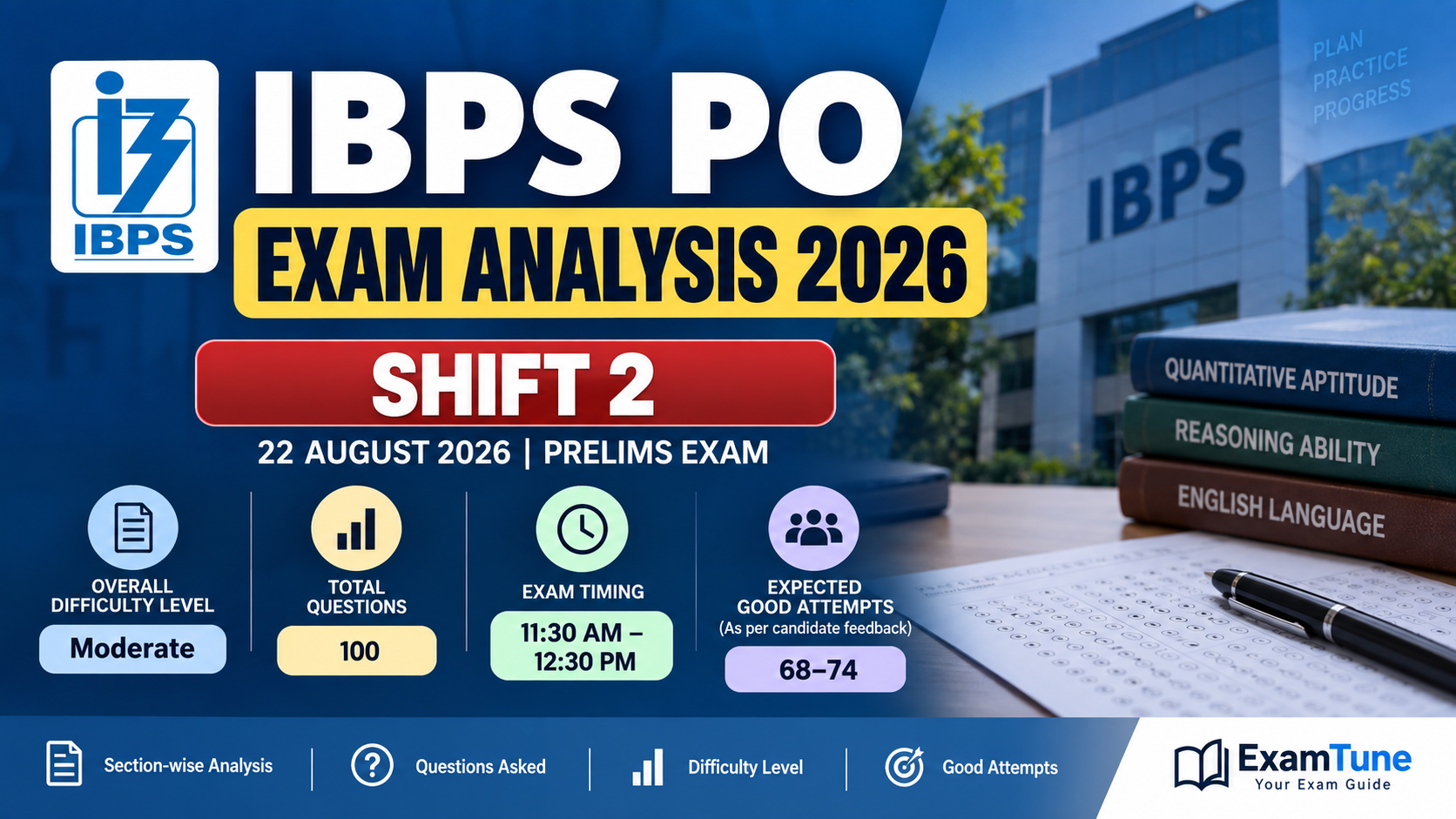
The IBPS PO Shift 2 Exam Analysis 2026 covers the second session conducted from 11:30 AM to 12:30 PM. Across major candidate-feedback analyses, the overall paper was most consistently rated Moderate. Quantitative Aptitude was usually described as the more calculation-intensive section.
IBPS PO Shift 2 English Language Analysis 2026
English Language contained 30 questions for 30 marks and had a separate 20-minute timer. Candidate reviews ranged from Easy to Moderate to Moderate.
| English Language | Shift 2 Analysis |
|---|---|
| Total Questions | 30 |
| Maximum Marks | 30 |
| Sectional Time | 20 Minutes |
| Difficulty | Easy to Moderate / Moderate |
| Consolidated Good Attempts | 20–25 |
English Language Questions Asked in Shift 2
Memory-based reports repeatedly mentioned the following topics in the second shift:
- Reading Comprehension
- Word Usage
- Word Swap
- Error Detection
- Phrase Replacement
- Double Fillers
- Para Jumble
- Vocabulary questions linked with Reading Comprehension
Some sources reported different counts for these topics and certain subparts may overlap. Therefore, this article does not force those conflicting counts into an exact 30-question total.
IBPS PO Shift 2 Reasoning Ability Analysis 2026
Reasoning Ability contained 35 questions for 40 marks with a 20-minute timer. Candidate feedback generally rated the section Easy to Moderate.
| Reasoning Ability | Shift 2 Analysis |
|---|---|
| Total Questions | 35 |
| Maximum Marks | 40 |
| Sectional Time | 20 Minutes |
| Difficulty | Easy to Moderate |
| Consolidated Good Attempts | 20–29 |
Reasoning Ability Questions Asked in Shift 2
The dominant areas were again Puzzles and Seating Arrangement. The following topics were repeatedly reported:
| Topic | Reported Questions / Coverage |
|---|---|
| Circular Seating Arrangement | About 5 |
| Month & Date-Based Puzzle | About 5 |
| Selection / Category-Based Puzzle | About 5 |
| Floor-Based Puzzle | About 5 |
| Chinese Coding / Coding-Decoding | About 5 |
| Blood Relation | About 3 |
| Inequality | About 3 |
| Syllogism | About 2 |
| Pair / Word / Meaningful Word-Based Questions | Reported in the remaining questions |
The precise split of the miscellaneous word/pair questions differs between memory-based sources, so the table above intentionally avoids presenting a conflicting 36-question total for a 35-question section.
IBPS PO Shift 2 Quantitative Aptitude Analysis 2026
Quantitative Aptitude contained 35 questions for 30 marks and was separately timed for 20 minutes. The section was consistently reported as Moderate and comparatively calculation-intensive.
| Quantitative Aptitude | Shift 2 Analysis |
|---|---|
| Total Questions | 35 |
| Maximum Marks | 30 |
| Sectional Time | 20 Minutes |
| Difficulty | Moderate |
| Consolidated Good Attempts | 17–23 |
Quantitative Aptitude Questions Asked in Shift 2
The strongest cross-source agreement was seen in the Shift 2 Quantitative Aptitude distribution. Candidate-feedback reports commonly listed the following:
| Topic | Reported Questions |
|---|---|
| Wrong Number Series | 3 |
| Approximation | 4 |
| Double Line Graph DI | 6 |
| Table DI | 6 |
| Caselet DI | About 2–3 |
| Q1/Q2 Type Questions | About 2 |
| Arithmetic | About 11 |
Arithmetic questions reportedly included standard bank-exam topics such as percentage, ratio, profit and loss, time and work, speed-distance and related application-based arithmetic.
IBPS PO Shift 1 vs Shift 2 Exam Analysis 2026
| Parameter | Shift 1 | Shift 2 |
|---|---|---|
| Date | 22 August 2026 | 22 August 2026 |
| Timing | 9:00 AM – 10:00 AM | 11:30 AM – 12:30 PM |
| English | Easy to Moderate | Easy to Moderate / Moderate |
| Reasoning | Easy to Moderate / Moderate | Easy to Moderate |
| Quant | Moderate | Moderate |
| Overall | Easy to Moderate / Moderate | Moderate |
| Overall Reported Good-Attempt Band Across Sources | Approx. 63–75 | Approx. 57–74 |
| Major Reasoning Trend | Puzzles & Seating Arrangement | Puzzles, Seating Arrangement & Coding |
| Major Quant Trend | DI, Approximation, Number Series, Arithmetic | DI, Wrong Number Series, Approximation, Arithmetic |
IBPS PO Prelims Exam Pattern 2026
Under the CRP PO/MT-XVI Preliminary Examination pattern, the paper contains 100 questions for 100 marks with a total duration of 60 minutes. Each section is separately timed for 20 minutes.
| Section | Questions | Maximum Marks | Time |
|---|---|---|---|
| English Language | 30 | 30 | 20 Minutes |
| Quantitative Aptitude | 35 | 30 | 20 Minutes |
| Reasoning Ability | 35 | 40 | 20 Minutes |
| Total | 100 | 100 | 60 Minutes |
Important IBPS PO 2026 Exam Pattern Point
The 2026 Preliminary Examination marking structure is not one mark per question in every section. Reasoning Ability has 35 questions for 40 marks, while Quantitative Aptitude has 35 questions for 30 marks.
Therefore, performance should be judged using marks, accuracy and the official scoring rules, not only the raw number of questions attempted.
IBPS PO Negative Marking 2026
Negative marking applies to the objective tests. For every incorrect answer, one-fourth of the marks assigned to that question is deducted while arriving at the corrected score.
There is no penalty for an unanswered question. Because the CRP PO/MT-XVI Prelims sections do not carry identical marks per question, it is more accurate to describe the penalty as one-fourth of the marks assigned to the specific question rather than as a universal flat 0.25 mark for every question.
IBPS PO 22 August 2026 Shift Timings
On 22 August 2026, the Preliminary Examination was conducted in four shifts. The first two shifts covered in this article were held at 9:00 AM and 11:30 AM respectively.
| Shift | Exam Timing | Status |
|---|---|---|
| Shift 1 | 9:00 AM – 10:00 AM | Completed – Detailed Analysis Above |
| Shift 2 | 11:30 AM – 12:30 PM | Completed – Detailed Analysis Above |
| Shift 3 | 2:00 PM – 3:00 PM | Completed |
| Shift 4 | 4:30 PM – 5:30 PM | Completed |
IBPS PO Exam Analysis 2026 – All Shift Status
The official IBPS calendar scheduled the PO Preliminary Examination for 22 and 23 August 2026. Candidate-feedback analysis pages reported four shifts on 22 August and two shifts on 23 August.
| Exam Date | Shift | Status on This Page |
|---|---|---|
| 22 August 2026 | Shift 1 | Detailed Analysis Updated |
| 22 August 2026 | Shift 2 | Detailed Analysis Updated |
| 22 August 2026 | Shift 3 | Exam Conducted |
| 22 August 2026 | Shift 4 | Exam Conducted |
| 23 August 2026 | Shift 1 | Exam Conducted |
| 23 August 2026 | Shift 2 | Exam Conducted |
What is a Good Attempt in IBPS PO Prelims 2026?
A good attempt in IBPS PO Prelims is an unofficial estimate of how many questions a well-prepared candidate may have been able to attempt with reasonable accuracy in a particular shift.
It is not the same as the official cut-off. Good attempts can differ between shifts because of changes in question difficulty, length and topic mix. Accuracy remains critical because incorrect responses attract negative marking.
ExamTune Analysis Tip
Do not compare only raw attempts across different shifts. Compare your expected score after accounting for accuracy, section-wise marks and negative marking. The official cut-off is decided by IBPS and cannot be derived only from an unofficial good-attempt range.
IBPS PO Prelims 2026 Shift 1 Key Highlights
- Shift 1 was conducted on 22 August 2026.
- Shift 1 timing was 9:00 AM to 10:00 AM.
- Overall level was reported between Easy to Moderate and Moderate across major analyses.
- English Language was generally Easy to Moderate.
- Reasoning Ability was generally Easy to Moderate / Moderate.
- Quantitative Aptitude was generally Moderate.
- Puzzles and seating arrangements dominated Reasoning.
- DI, Number Series, Approximation and Arithmetic were major Quant areas.
IBPS PO Prelims 2026 Shift 2 Key Highlights
- Shift 2 was conducted on 22 August 2026.
- Shift 2 timing was 11:30 AM to 12:30 PM.
- Overall paper was most consistently reported as Moderate.
- English Language ranged from Easy to Moderate to Moderate.
- Reasoning Ability was generally Easy to Moderate.
- Quantitative Aptitude was Moderate and comparatively calculation-intensive.
- Reasoning included multiple puzzle/seating sets and coding-decoding.
- Quant included Double Line Graph DI, Table DI, Caselet DI, Wrong Number Series, Approximation and Arithmetic.
- English reports included RC, Word Swap, Phrase Replacement, Double Fillers and Para Jumble.
IBPS PO Mains Exam Date 2026
According to the official IBPS 2026–27 examination calendar, the IBPS PO Mains Exam 2026 is scheduled for 4 October 2026.
As of 11 September 2026, the Preliminary Examination has been completed and the official CRP PO/MT-XVI page had not yet listed a Prelims result notice. Candidates should follow IBPS for the official result and further Main Examination updates.
For the Main Examination, candidates should prepare according to the latest CRP PO/MT-XVI scheme, including Reasoning, General/Economy/Banking/Digital/Financial Awareness, English Language, Data Analysis & Interpretation and the Descriptive Paper.
Memory-Based Question Notice
Topic-wise question counts, puzzle descriptions, Reading Comprehension themes and Data Interpretation formats are based on candidates’ recollection and post-exam analysis. Minor differences may exist between sources because IBPS does not release an official shift-wise question-distribution sheet immediately after the examination.
Conclusion
The updated IBPS PO Exam Analysis 2026 for 22 August Shift 1 and Shift 2 shows that both sessions required balanced speed and accuracy. Shift 1 was generally placed between Easy to Moderate and Moderate, while Shift 2 was more consistently rated Moderate.
The IBPS PO Shift 1 Exam Analysis showed a strong presence of puzzles and seating arrangements in Reasoning and DI, Number Series, Approximation and Arithmetic in Quantitative Aptitude. The IBPS PO Shift 2 Exam Analysis again featured multiple puzzle sets, coding-decoding, Double Line and Table DI, Wrong Number Series, Arithmetic and a varied English section.
Candidates should treat all good-attempt figures as unofficial estimates and rely on the official IBPS website for the result, cut-off and further recruitment updates. The Main Examination is scheduled for 4 October 2026.
Disclaimer
Good attempts, difficulty levels, topic-wise question counts and memory-based exam details are based on candidate feedback and post-exam analysis. They are not officially released by IBPS. Official exam dates, recruitment notices, results and other authoritative updates should always be checked on the IBPS website.
Additional Important Article
Related Articles
- IBPS PO Mains Admit Card
- IBPS PO Vacancy
- IBPS PO Important Topics
- IBPS PO Salary
- IBPS PO Job Profile
- IBPS PO Cut Off
- IBPS PO Previous Papers
- IBPS PO First Attempt Strategy
- IBPS PO Interview Tips
- IBPS PO Admit Card
- IBPS PO Age Limit
- IBPS PO Declaration
IBPS Official Links
Popular Online Live Classes



Bank Maha Pack | Complete Subscription for IBPS, RRB & SBI Exams 2026-27
Frequently Asked Questions
When was IBPS PO 2026 Shift 1 held?
It was held on 22 August 2026.
What was the Shift 1 exam timing?
Shift 1 was held from 9:00 AM to 10:00 AM.
What was the overall difficulty of Shift 1?
The overall paper was assessed as Moderate.
What were the overall good attempts in Shift 1?
Around 65–71 attempts were considered good in one major candidate-feedback analysis.
How many questions were asked in IBPS PO Prelims?
The exam contained 100 questions.
What was the duration of the Prelims exam?
The total duration was 60 minutes.
Which sections were asked in Shift 1?
English Language, Quantitative Aptitude and Reasoning Ability were asked.
Was Quantitative Aptitude difficult in Shift 1?
It was reported as Moderate and somewhat time-consuming
Was English Language difficult in Shift 1?
English was assessed as Easy to Moderate.
Are IBPS PO good attempts officially released by IBPS?
No. Good attempts are estimates based on candidate feedback and expert analysis, not an official IBPS figure
About the Author

Practice free quizzes, mock tests, current affairs and exam-wise preparation resources on ExamTune.