IBPS Clerk Exam Pattern 2026: New Prelims & Mains Pattern
Quick Overview
Practice free quizzes, mock tests, current affairs and exam-wise preparation resources on ExamTune.
Download PDF
Download the latest IBPS Clerk Prelims and revised Mains exam pattern with section-wise questions, marks, sectional timing and negative-marking rules.
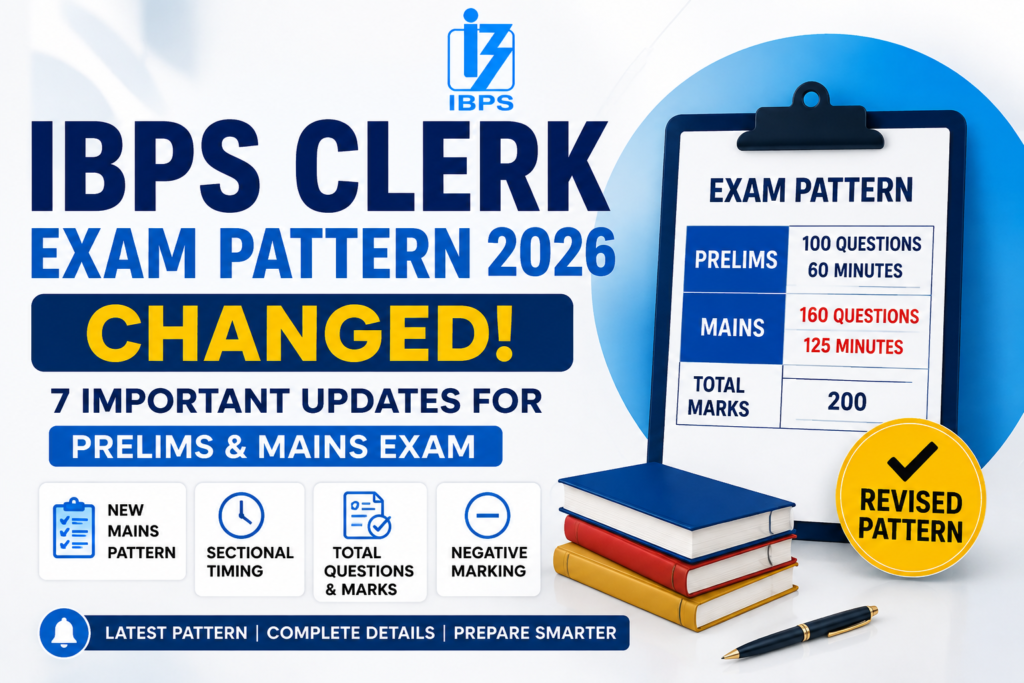
The IBPS Clerk Exam Pattern 2026 has been released for the Customer Service Associate recruitment cycle, CRP CSA-XVI. Candidates should prepare according to the latest section-wise questions, marks and timing because the Mains pattern has changed. The Prelims pattern remains unchanged, but the Mains examination now contains 160 questions, 200 marks and 125 minutes.
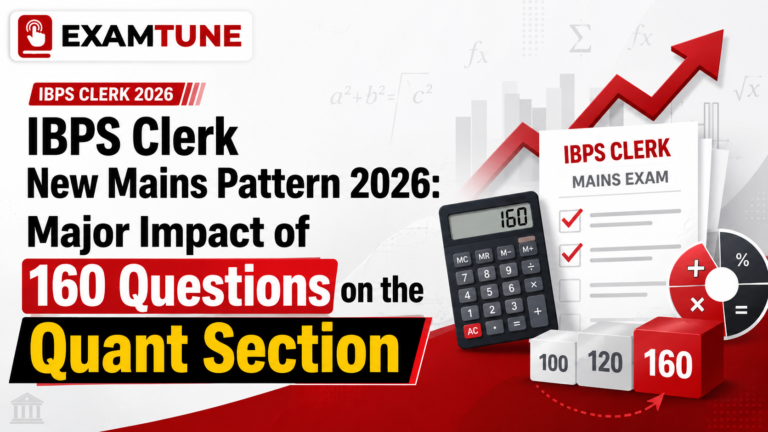
The main change is in Quantitative Aptitude: the section now has 40 questions instead of 35 and 35 minutes instead of 30 minutes. This updated guide explains the Prelims and Mains pattern, sectional timing, exam medium, negative marking, qualifying rules and the practical effect of the revised Mains structure.
IBPS Clerk Exam Pattern 2026 Overview
| Particular | Current Structure |
|---|---|
| Official Post Name | Customer Service Associate (CSA) |
| Recruitment Cycle | CRP CSA-XVI |
| Conducting Authority | Institute of Banking Personnel Selection (IBPS) |
| Online Exam Stages | Preliminary Examination and Main Examination |
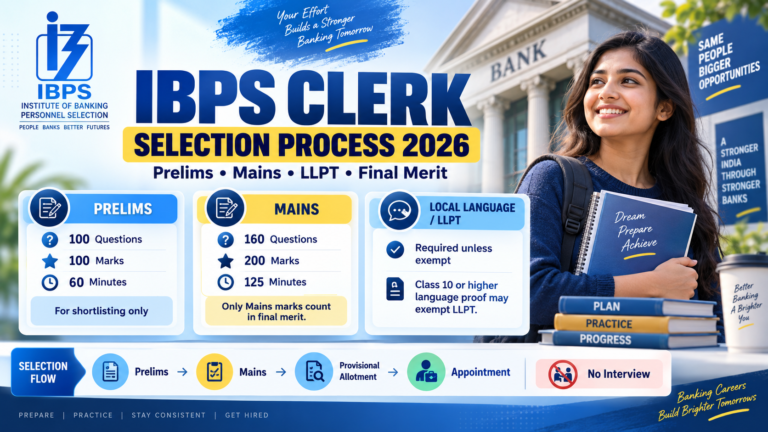
| Prelims | 100 questions, 100 marks, 60 minutes |
| Mains | 160 questions, 200 marks, 125 minutes |
| Sectional Timing | Applicable in both Prelims and Mains |
| Negative Marking | One-fourth of the marks assigned to the question for each wrong answer |
| Final Merit | Based on Online Main Examination marks |
| Interview | No interview |
What Changed in IBPS Clerk Mains Exam Pattern 2026?
The 2026 change is concentrated in Mains Quantitative Aptitude and the total Mains duration. The other three Mains sections retain their stated question, mark and time distribution.
| Particular | Previous Pattern | 2026 Pattern | Change |
|---|---|---|---|
| Total Mains Questions | 155 | 160 | +5 |
| Total Mains Duration | 120 minutes | 125 minutes | +5 minutes |
| Quant Questions | 35 | 40 | +5 |
| Quant Time | 30 minutes | 35 minutes | +5 minutes |
| Total Mains Marks | 200 | 200 | No change |
| Prelims Pattern | 100 Q / 100 marks / 60 min | 100 Q / 100 marks / 60 min | No change |
1. Mains Questions Increased to 160
The Main Examination now contains 160 objective questions instead of 155. Candidates should verify that their latest full-length mocks follow the 160-question structure.
2. Mains Duration Increased to 125 Minutes
The total sectional duration is now 125 minutes instead of 120 minutes. The extra five minutes are reflected in the Quantitative Aptitude section.
3. Quantitative Aptitude Increased to 40 Questions
Quantitative Aptitude now includes 40 questions for 50 marks. Candidates should practise according to the revised question count instead of stopping at the older 35-question format.
4. Quantitative Aptitude Time Increased to 35 Minutes
The section now provides 35 minutes. Because both the number of questions and time increased by five, careful question selection, calculation speed and Data Interpretation practice remain important.
IBPS Clerk Prelims Exam Pattern 2026
The Preliminary Examination is the qualifying stage used to shortlist candidates for Mains. It has three separately timed sections. Prelims marks are not added to the final merit score.
| Section | Medium | Questions | Marks | Time |
|---|---|---|---|---|
| English Language | English | 30 | 30 | 20 minutes |
| Numerical Ability | English, Hindi and applicable regional languages* | 35 | 35 | 20 minutes |
| Reasoning Ability | English, Hindi and applicable regional languages* | 35 | 35 | 20 minutes |
| Total | — | 100 | 100 | 60 minutes |
*The available regional-language medium depends on the State/UT selected. English Language is tested only in English. Candidates should confirm the exact medium table in the official notification.
Key Prelims Rules
- Each section has a separate 20-minute timer.
- Candidates must qualify in each test by securing cut-off marks decided by IBPS.
- An adequate number of candidates in each category are shortlisted for Mains based on requirements.
- Prelims marks are not included in final merit.
- Wrong answers attract a penalty of one-fourth of the marks assigned to that question.
Also check the IBPS Clerk Syllabus 2026 and IBPS Clerk expected cut-off for topic-wise preparation and score planning.
IBPS Clerk Mains Exam Pattern 2026
The Mains examination is the merit-deciding online stage. The revised paper has four separately timed tests, 160 questions, 200 marks and 125 minutes.
| Test | Medium | Questions | Marks | Time |
|---|---|---|---|---|
| General / Financial Awareness | English, Hindi and applicable regional languages* | 40 | 50 | 20 minutes |
| General English | English | 40 | 40 | 35 minutes |
| Reasoning Ability | English, Hindi and applicable regional languages* | 40 | 60 | 35 minutes |
| Quantitative Aptitude | English, Hindi and applicable regional languages* | 40 | 50 | 35 minutes |
| Total | — | 160 | 200 | 125 minutes |
*Confirm the State/UT-specific regional-language medium in the official notification. The tests are separately timed and may appear in an order specified by IBPS.
IBPS Clerk Exam Pattern 2025 vs 2026
The Prelims structure is unchanged. The Mains revision adds five Quantitative Aptitude questions and five minutes to that section, increasing the overall Mains totals from 155 to 160 questions and from 120 to 125 minutes.
Preparation impact: Candidates using old full-length Mains mocks should not simply add five questions without changing the sectional timer. Use mocks that provide 40 Quant questions in 35 minutes and a complete 160-question paper in 125 minutes.
IBPS Clerk Negative Marking 2026
For each wrong answer in the objective tests, one-fourth of the marks assigned to that question is deducted. There is no penalty for a question left unanswered.
| Marks Assigned to a Question | Penalty for a Wrong Answer |
|---|---|
| 1 mark | 0.25 mark |
| 1.25 marks | 0.3125 mark |
| 1.5 marks | 0.375 mark |
Qualifying Marks and Final Selection
- Prelims is qualifying and is used to shortlist candidates for Mains.
- Candidates must meet the qualifying requirements prescribed by IBPS in the tests and overall examination, as applicable.
- Final merit and provisional allotment are based on Online Main Examination marks.
- There is no interview for the Customer Service Associate post.
- Local-language proficiency and document requirements apply according to the official notification and participating bank process.
Preparation Strategy for the Revised Exam Pattern
For Prelims
- Practise English, Numerical Ability and Reasoning in separate 20-minute blocks.
- Prioritise easy and moderate questions before lengthy puzzles or calculations.
- Track speed, accuracy and skipped easy questions after every mock.
For Mains
- Use full mocks based on 160 questions and 125 minutes.
- Practise 40 Quant questions in 35 minutes, including Arithmetic and Data Interpretation.
- Prepare Reasoning for its 60-mark weightage and fixed 35-minute timer.
- Revise banking, economy, schemes and financial awareness consistently.
- Do not use one section’s assumed spare time in another section; practise within the stated sectional limits.
- Analyse negative marks and avoid low-confidence guessing.
For a structured roadmap, read How to Crack IBPS Clerk in the First Attempt.
Related IBPS Clerk 2026 Guides
Conclusion
The IBPS Clerk Exam Pattern 2026 keeps the Prelims structure at 100 questions, 100 marks and 60 minutes. The revised Mains examination has 160 questions, 200 marks and 125 minutes. The main change is in Quantitative Aptitude, which now contains 40 questions with 35 minutes. Candidates should update their mock-test format, practise within sectional timing and follow the official one-fourth negative-marking rule.
Official Source & Verification
Source: IBPS CRP CSA-XVI Detailed Notification.
Candidates should check ibps.in for any subsequent corrigendum or examination update.
Popular Online Live Classes

SBI Clerk 2026 Complete Target (Junoon) Batch | SBI Clerk 2026 Pre + Mains

Bank Maha Pack | Complete Subscription for IBPS, RRB & SBI Exams 2026-27
Frequently Asked Questions
What is the IBPS Clerk Exam Pattern 2026?
The IBPS Clerk Exam Pattern 2026 includes two online stages: Prelims and Mains. Prelims has 100 questions for 100 marks in 60 minutes, while Mains has 160 questions for 200 marks in 125 minutes.
Has the IBPS Clerk Exam Pattern changed in 2026?
Yes. The Prelims pattern remains unchanged, but the Mains pattern has been revised. Mains now contains 160 questions instead of 155, and its total duration has increased from 120 to 125 minutes.
What is the IBPS Clerk Mains Exam Pattern 2026?
IBPS Clerk Mains has four sections: General/Financial Awareness, General English, Reasoning Ability and Quantitative Aptitude. It contains 160 questions for 200 marks and must be completed within the prescribed sectional duration of 125 minutes.
How many questions are asked in IBPS Clerk Mains 2026?
IBPS Clerk Mains has four sections: General/Financial Awareness, General English, Reasoning Ability and Quantitative Aptitude. It contains 160 questions for 200 marks and must be completed within the prescribed sectional duration of 125 minutes.
What is the sectional timing for IBPS Clerk Prelims and Mains?
In Prelims, English, Numerical Ability and Reasoning Ability receive 20 minutes each. In Mains, General/Financial Awareness receives 20 minutes, while General English, Reasoning Ability and Quantitative Aptitude receive 35 minutes each.
How many sections are there in IBPS Clerk Prelims and Mains?
Prelims has three separately timed sections: English Language, Numerical Ability and Reasoning Ability. Mains has four: General/Financial Awareness, General English, Reasoning Ability and Quantitative Aptitude.
Is there negative marking in the IBPS Clerk Exam 2026?
Yes. One-fourth of the marks assigned to a question is deducted for every incorrect answer. No penalty is imposed when a question is left unanswered.
Are IBPS Clerk Prelims marks counted in the final merit list?
No. Prelims marks are used only to shortlist candidates for the Mains examination. Final merit and provisional allotment are based on marks obtained in the Online Main Examination.
Is there an interview or descriptive paper in the IBPS Clerk Exam?
No. IBPS Clerk Prelims and Mains are objective-type online examinations. There is no descriptive paper or interview for recruitment to the Customer Service Associate post.
Can candidates switch between sections in the IBPS Clerk Exam?
No. Every section is separately timed. Candidates must answer questions within the allotted sectional time and follow the sequence and instructions displayed in the examination interface.
About the Author

Practice free quizzes, mock tests, current affairs and exam-wise preparation resources on ExamTune.