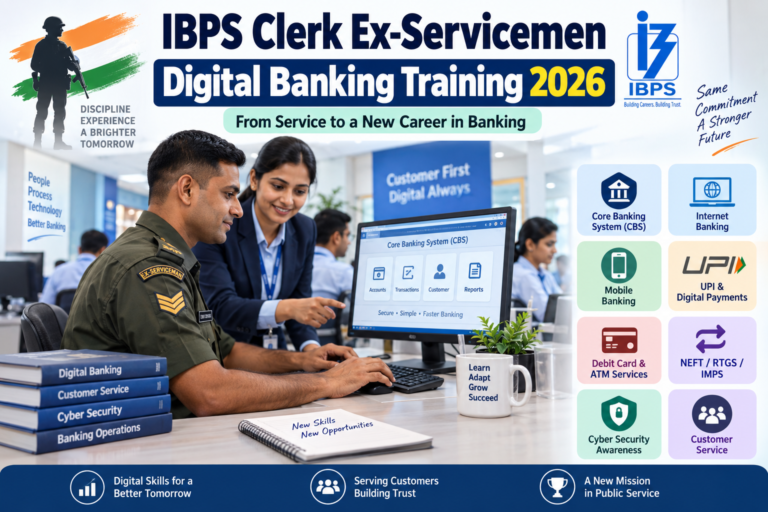
IBPS Clerk Ex-Servicemen Core Banking System (CBS) 2026: Features, Functions & Banking Operations Guide
Quick Overview
Practice free quizzes, mock tests, current affairs and exam-wise preparation resources on ExamTune.
Core Banking System (CBS): Beginner Notes for Ex-Servicemen
Learn CBS functions, clerk responsibilities and safe banking practices with ExamTune’s beginner notes and 10 FAQs. Independent study material, not an official IBPS or bank software manual.
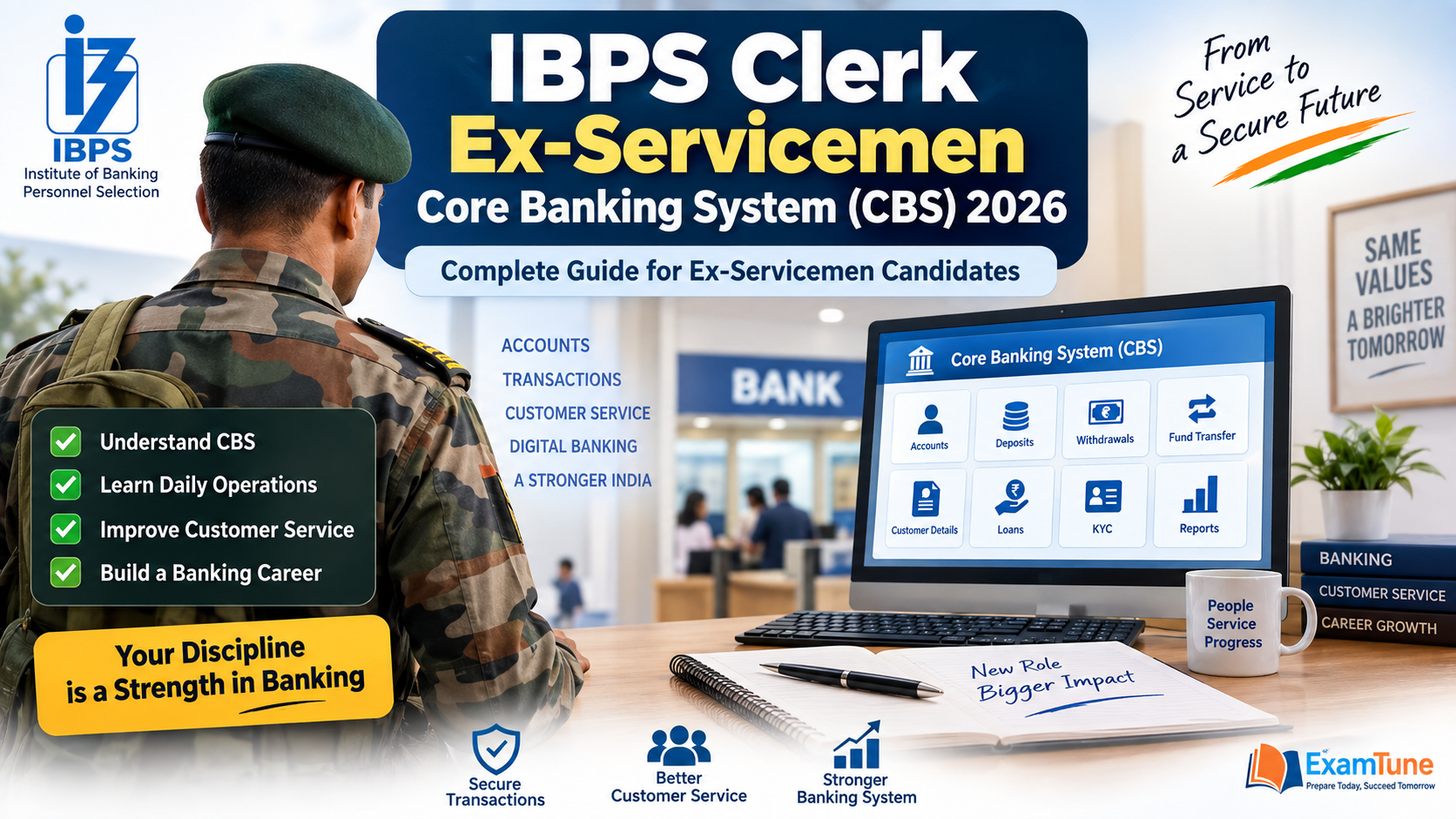
IBPS Clerk Ex-Servicemen Core Banking System is a beginner-friendly guide to the banking technology that Customer Service Associates may use after joining a bank. A Core Banking System (CBS), also commonly called a Core Banking Solution, helps maintain account records and process core banking transactions across a connected banking network.
This guide explains CBS functions, customer services, software examples and safe working practices. It is not an official IBPS software course or a bank’s operating manual. The year in the article title identifies this guide’s edition, not a particular CBS software version.
Important: Customers use branches and customer-facing channels such as internet banking. They do not receive unrestricted access to employees’ CBS screens. An employee’s permitted activities depend on the bank’s assigned duties, system privileges and approval procedures.
IBPS Clerk Ex-Servicemen Core Banking System (CBS) Overview
| Particular | Details |
|---|---|
| Exam Name | IBPS Clerk / Customer Service Associate recruitment |
| Post | Customer Service Associate (CSA), commonly called Clerk |
| Intended Readers | Ex-Servicemen preparing for a banking career |
| System | Core Banking System / Core Banking Solution (CBS) |
| Purpose | Maintain shared account records and process core banking transactions |
| Employee Access | Authorised users, according to assigned responsibilities and system permissions |
| Customer Access | Through permitted branch services and connected customer-facing channels |
| Software and Training | Bank-specific; this guide does not replace the bank’s instructions |
What is Core Banking System (CBS)?
CBS connects core account-processing functions so that authorised branches and applications can work with shared banking records. Typical functions include maintaining deposit accounts, recording debits and credits, supporting transfers, and handling relevant loan-account records.
“Any-branch banking” normally means an eligible CBS-enabled branch of the same bank. It does not mean that every bank can operate every other bank’s accounts. Services outside the home branch remain subject to the bank’s rules and service availability.
For example, Model Co-operative Bank’s CBS explanation describes connected branches providing account enquiries, deposits, statements and specified transfers. It is a useful illustration of CBS, not a statement that this bank participates in IBPS Clerk recruitment.
Why is CBS Important for IBPS Clerk?
A Customer Service Associate may work with CBS and related applications when handling assigned branch duties. Understanding account details, transaction status and approval requirements helps a beginner connect classroom banking concepts with practical work.
CBS supports quicker access to relevant records, less repeated manual entry and more consistent customer service. However, a clerk does not automatically have permission to perform every function available in the software. For a broader view of responsibilities, read the IBPS Clerk Job Profile guide.
Major Features of Core Banking System
Features vary by product and the bank’s implementation. Common capabilities include:
- Shared account records: connected branches can retrieve the information needed for permitted services.
- Transaction processing: recording deposits, withdrawals, transfers and related account movements.
- Product support: managing deposit and lending products through configured business rules.
- Integration: connecting core account processing with other banking applications and service channels.
- Reporting: supporting statements, transaction enquiries and operational records.
Not every service sits inside one application. Card management, customer onboarding, cheque clearing or other functions may involve separate connected systems. The Oracle core-banking overview illustrates this broader banking-technology environment.
Daily Use of CBS by IBPS Clerk
Depending on the assigned counter or role, day-to-day work may include account enquiries, cash transaction entries, passbook printing, statement generation and processing supported service requests.
Entry and approval are not interchangeable. The CSA duties published by AIBEA distinguish activities such as uploading verified KYC information from supervisory verification. They also distinguish NEFT/RTGS data entry from the prescribed supervisory authorisation.
Follow the applicable duty allocation and bank procedures. Some permitted activities may be completed within the employee’s own authority, while others require another authorised person’s verification.
Customer Services Performed Through CBS
CBS and connected applications can support services such as:
- Account-opening support and permitted customer-record updates.
- Balance enquiries, account statements and passbook updates.
- Cash deposits, withdrawals and eligible fund transfers.
- Fixed-deposit and other deposit-account servicing.
- Cheque-related processing and requests for banking facilities.
- Loan-account enquiries and permitted servicing entries.
Recording a request does not necessarily mean that it is approved or completed. Explain the actual transaction status and any required next step rather than promising immediate completion.
Advantages of CBS for Customers
Customers can benefit from easier access to eligible services across connected branches, more convenient account enquiries and coordinated banking records. They need not depend exclusively on the branch where the account was originally opened for every supported service.
However, CBS does not guarantee that every request is instant or unrestricted. Cheque processing, approvals, service limits and technical availability can affect completion. A recorded transaction should not be confused with a cheque having cleared.
Advantages of CBS for Bank Employees
For employees, shared records can reduce repetitive work and make account enquiries and transaction follow-up easier. Automated product rules and connected applications can support consistent processing.
These benefits do not remove the need for careful checking. Entering a wrong account number or amount can still create an operational problem. Software supports the employee’s work; it does not replace responsibility for following the authorised process.
Role of Ex-Servicemen in CBS Operations
Ex-Servicemen can build confidence by practising basic computer skills, learning banking terminology and asking for clarification whenever a procedure is unfamiliar. Prior service experience can provide useful habits, but banking procedures still need to be learned.
There is no reason to assume a separate CBS simply because an employee belongs to the Ex-Servicemen category. Access follows the bank’s role allocation, not an unrestricted category-based permission. Learn the system used by the allotted bank rather than expecting every bank’s screens to be identical.
How Does CBS Work? A Simple Learning Example
Illustrative example, not a bank operating procedure: A customer visits another eligible branch of the same bank to make a permitted cash deposit.
- The authorised employee identifies the account and checks the request under the bank’s procedure.
- The transaction details are entered and the required checks or approvals are completed.
- Once successfully posted, the deposit is reflected in the bank’s account records.
- The customer receives the appropriate acknowledgement and can check the updated transaction through an available channel.
The key learning is the sequence: identify the request, complete required checks, confirm successful posting, then communicate the result. Actual screens, controls and responsibilities differ between banks.
Is CBS the Same as Internet Banking?
No. CBS supports the bank’s core account processing. Internet banking and mobile banking are customer-facing channels that connect with the bank’s systems to provide permitted services.
Think of a customer’s online request and the underlying account entry as connected parts of a service, not the same employee login. Similarly, a card request may pass through a separate card-management application. An employee should know which system handles the request and how to check its status.
Examples of Core Banking Software
Infosys Finacle and Oracle FLEXCUBE are examples of commercial core-banking solutions. They are not IBPS-branded software packages.
Knowing these names helps a beginner recognise common industry terminology. It does not establish which product, version or menu configuration a particular bank will assign. Public product information is useful for concepts; the bank’s authorised materials govern actual operations.
Safe CBS Working Practices
RBI’s commercial-bank technology and cybersecurity directions emphasise need-based access, separation of responsibilities, audit records and staff awareness. Apply the bank’s instructions when working with customer information.
- Use only your authorised access; do not share staff credentials.
- View or change information only for assigned work.
- Follow required checking and approval steps.
- Keep customer records out of personal messaging, photos and public training examples.
- Report suspected errors or suspicious activity through the approved channel.
Refer to the RBI commercial-bank cybersecurity and technology directions for the regulatory framework. These directions are not a menu-by-menu CBS training manual.
What Should Beginners Learn Before Joining?
Suggested learning sequence: practise accurate typing and number entry, learn basic account and transaction terms, study simple fictional banking examples, and then follow the bank’s approved training. Use dummy details for practice, never real customer records.
The checked IBPS CSA-XVI notification requires computer literacy through the stated qualification or subject-study routes. It does not name a separate Finacle or CBS certification as an eligibility requirement. Basic practice alone is not a substitute for any documentary eligibility requirement.
Read the Computer Certificate for IBPS Clerk guide and verify the relevant clause in the IBPS-issued CSA-XVI notification, hosted by CareerPower. This linked copy is not hosted on the IBPS website; follow subsequent official notices on ibps.in.
For examination preparation, use the IBPS Clerk Ex-Servicemen Preparation Strategy. Treat this CBS article as introductory banking awareness and workplace orientation, not a substitute for the notified examination syllabus.
IBPS Clerk Ex-Servicemen Core Banking System: Final Advice
Learn what CBS does, distinguish a request from a completed transaction, and understand the difference between entering information and approving it. Accuracy, confidentiality and asking the right questions are more useful than memorising unverified software shortcuts.
ExamTune editorial guide: The learning example and preparation sequence above are educational suggestions. Actual duties, system access and operating procedures are determined by the employing bank.
Popular Online Live Classes



Ex-Servicemen IBPS Clerk 2026 Parakram Batch | IBPS Clerk Pre + Mains Course
Frequently Asked Questions
What is the Core Banking System (CBS)?
CBS is a centralized banking system that allows customers to access banking services from any branch of the bank.
Why is CBS important for an IBPS Clerk?
CBS helps IBPS Clerks process transactions, manage accounts, and provide faster customer service.
What tasks are performed using CBS?
CBS is used for account management, cash transactions, fund transfers, passbook updates, and customer information.
Do new IBPS Clerks receive CBS training?
Yes, banks generally provide training on CBS and other banking software after joining.
Is computer knowledge necessary to use CBS?
Yes, basic computer skills help employees learn and use the Core Banking System efficiently.
Can Ex-Servicemen learn CBS easily?
Yes, with proper training and regular practice, Ex-Servicemen can quickly become familiar with CBS operations.
Is CBS used in all Public Sector Banks?
Yes, Public Sector Banks use Core Banking Systems to manage banking operations across branches.
Does CBS improve customer service?
Yes, CBS enables faster transactions, quick account access, and efficient customer support.
What are the benefits of CBS for bank employees?
CBS improves work efficiency, reduces manual work, enhances accuracy, and simplifies banking operations.
Where can candidates learn about CBS before joining?
Candidates can understand CBS basics through banking awareness resources, training material, and official bank learning programs.
About the Author

Practice free quizzes, mock tests, current affairs and exam-wise preparation resources on ExamTune.