IBPS Clerk Ex-Servicemen Digital Banking Training 2026: Online Banking, UPI, Core Banking & Customer Service Guide
Quick Overview
Practice free quizzes, mock tests, current affairs and exam-wise preparation resources on ExamTune.
Download PDF
RBI financial-awareness booklet, Fourth Edition (February 2024). General reading, not an IBPS ESM training manual. Check current bank instructions for limits and procedures.
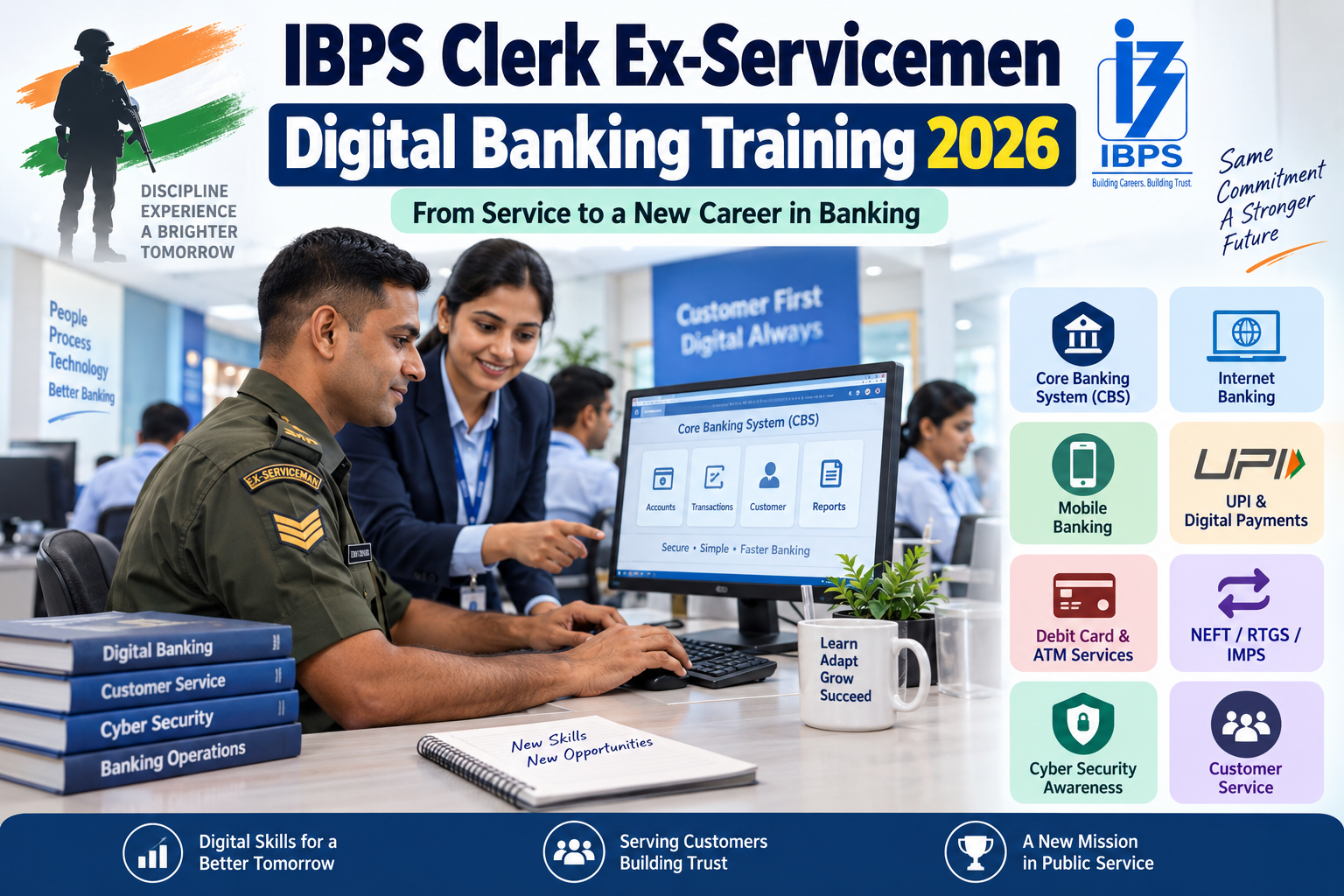
IBPS Clerk ESM Digital Banking is an ExamTune learning guide for Ex-Servicemen preparing to work as Customer Service Associates in participating Public Sector Banks. Learn what to ask about CBS, UPI, electronic transfers, customer support and safe handling of information before starting assigned duties.
This is not an IBPS-issued digital banking course notice or a uniform ESM training syllabus. After appointment, follow the employing bank’s induction schedule, approved operating procedures and role permissions. The topics below are a learning checklist, not a promise that every employee receives identical modules, software access or training duration.
Digital services operate alongside cash handling, documentation and other branch work. This IBPS Clerk Ex-Servicemen Digital Banking Training 2026 guide includes seven practical learning tips. Keep examination preparation, recruitment eligibility and post-joining training separate.
IBPS Clerk ESM Digital Banking: Training Overview
| Particular | Details |
|---|---|
| Recruitment | IBPS Clerk / Customer Service Associate |
| Audience | Ex-Servicemen preparing for, or beginning, a banking career |
| Guide type | Independent job-readiness and digital-banking awareness guide |
| Training authority | The employing bank, through its training and operational instructions |
| Learning areas | CBS, customer support, payments, fraud awareness and information security |
| Duration and assessment | Bank-specific; obtain the applicable induction schedule |
| System access | Only the applications and functions authorised for the employee’s role |
What is IBPS Clerk Ex-Servicemen Digital Banking Training?
Digital banking training helps employees understand technology-supported customer services and the bank’s internal workflows. It can involve classroom learning, approved online modules and supervised work, depending on the bank.
For example, Bank of Baroda describes induction for newly recruited clerks using classroom and on-the-job training. That is an example of a bank’s arrangement, not a timetable applicable to every participating bank.
Keep three things separate: examination preparation, computer-literacy eligibility and operational training after joining. A short awareness course should not be assumed to replace the computer qualification or subject-study evidence prescribed for recruitment. Check the ESM eligibility guide and the relevant notification.
Who Provides the Training and How Long Does It Take?
The employing bank provides the applicable induction instructions. Ask its training or HR team which modules, assessments and supervised tasks apply to your role. There is no common duration promised in this guide, and completing an awareness module does not itself authorise live transactions.
Why is Digital Banking Training Important?
The practical goal is to help customers without exposing their money or information to avoidable risk. Use training to build accuracy, understand service limits and recognise when a request needs an authorised colleague.
- Explain the difference between a completed payment, a pending transaction and a complaint.
- Give clear guidance without collecting a customer’s secret credentials.
- Check official instructions rather than guessing about activation, charges or refunds.
Core Banking Solution (CBS) Training
A Core Banking Solution (CBS) supports centralised account records and banking transactions. Learn the platform used by your bank; do not assume every institution uses the same product or menu names.
Suggested learning tasks, where assigned, include:
- Customer and account enquiries, transaction histories and record verification.
- Account-opening support and checking required documents.
- Cash or transfer entries, receipts and transaction references.
- Understanding error messages and routing corrections through the approved process.
Use your own authorised login. Where maker-checker controls apply, entering a transaction and approving it are separate responsibilities. Never borrow a colleague’s credentials or bypass an approval step.
Practise only in a bank-approved training environment or under authorised supervision.
Internet Banking Training
Build a checklist for explaining registration, statement downloads, bill payments and transfer options through the bank’s official website. Follow the bank’s verification process for account access or password-reset requests.
Guidance is not permission to know the customer’s password. Let the customer complete private authentication. Do not request, record or repeat an OTP, PIN, password or card security code. Bank of Baroda’s customer-support safety advice warns against sharing these details.
Mobile Banking Training
Learn the bank’s supported mobile application and approved help process. A useful demonstration covers registration requirements, balance and statement options, payment history and locating official customer support.
- Check the official app link and publisher instead of installing an APK received through a message.
- Explain device-change or registration issues using the bank’s instructions.
- Keep customer authentication private and use approved demonstration material.
Do not install remote-control software or ask customers to share their banking screen to complete routine assistance. Avoid using your personal account or mobile number as a substitute for the customer’s required details.
UPI & Digital Payment Training
Unified Payments Interface (UPI) supports digital payments through participating applications. A useful learning checklist covers UPI IDs, payee confirmation, QR payments, transaction history and complaint references.
For an ordinary incoming UPI payment, the recipient does not need to enter a UPI PIN or scan someone else’s QR code. Explain that a request to do this to receive a refund or prize is a warning sign. Check the displayed beneficiary and amount before authorising a payment.
Use the bank or application’s current instructions for authentication, supported features and limits. Do not assume one limit applies to every UPI use case. Read Indian Overseas Bank’s UPI safety tips for customer-facing precautions.
UPI reversal deadlines: Under RBI’s domestic failed-transaction framework, an account debit without beneficiary credit requires reversal by T + 1 day if credit cannot be completed. A debit without transaction confirmation at the merchant requires reversal within T + 5 days. T is the transaction’s calendar date; compensation of ₹100 per day beyond the applicable deadline is automatic. Keep the transaction reference and identify the failure category. These timelines do not describe merchant cancellation refunds or fraud-recovery claims.
Debit Card & ATM Banking Services
Suggested learning areas include card activation guidance, official PIN-generation channels, lost-card reporting, replacement requests and ATM transaction complaints.
The customer should set or enter the PIN privately. Learn how an urgent blocking request is routed and what verification is required; do not delay suspected-fraud escalation while discussing routine replacement steps.
For a cash-not-dispensed complaint, record the relevant date, amount, terminal details and transaction reference through the authorised system. Do not promise an identical reversal deadline for every card or payment incident.
IBPS Clerk ESM Digital Banking Responsibilities
Discuss your assigned duties with the branch supervisor. The IBPS Clerk job-profile guide gives broader context, but only the employing bank can authorise particular transactions or approvals.
| Situation | Suggested service approach |
|---|---|
| Customer needs digital-service guidance | Explain the official process and preserve private authentication. |
| Transaction is pending or failed | Check the available reference and status; register or route the complaint. |
| Unauthorised transaction is suspected | Escalate immediately through the bank’s fraud-reporting process. |
| Request exceeds your authority | Refer it to the designated officer or support team. |
Customer assistance does not give an employee unrestricted monitoring access, authority to approve every refund or permission to disclose account information.
Three Customer-Service Scenarios to Practise
The following are illustrative learning exercises, not a replacement for the bank’s operating procedure. Discuss each response with an authorised trainer.
- A customer offers an OTP for help: Do not accept or record it. Explain the official process while the customer completes private authentication.
- An ATM withdrawal is disputed: Collect the relevant transaction reference through the approved complaint process. Avoid promising a refund before the case is checked.
- A payment screenshot is shown as proof: Check the authorised transaction record rather than treating the screenshot alone as confirmation.
NEFT, RTGS & IMPS Training
Understand the payment system before explaining availability and limits. The following are system-level features; bank and channel restrictions still matter.
| System | Key point |
|---|---|
| NEFT | Available 24×7 and processed in half-hourly batches. RBI does not prescribe a transfer-amount ceiling for account-to-account NEFT; banks can set limits. |
| RTGS | Available 24×7, with individual real-time settlement. The minimum is ₹2 lakh; RBI sets no upper ceiling. Bank or channel limits may apply. |
| IMPS | An immediate, round-the-clock transfer service. Check the bank’s supported channel and transaction or daily limits. |
References: RBI NEFT FAQs, RBI RTGS FAQs and NPCI’s IMPS overview.
24×7 payment-system availability does not mean every branch counter is open all day. Check beneficiary details, applicable charges and the relevant bank instructions before assisting with a transfer.
AePS & Aadhaar Enabled Banking Services
The Aadhaar Enabled Payment System (AePS) is a bank-led service using Aadhaar authentication at supported touchpoints. Services can include cash withdrawal, balance enquiry and mini statements; availability depends on the participating bank and authorised touchpoint.
Learn the approved customer-consent, identity-verification, authentication and receipt procedures before handling an assigned AePS role. Do not treat Aadhaar possession alone as permission to transact or store authentication information in personal files.
Read NPCI’s AePS information and follow the bank’s implementation of UIDAI authentication requirements. Not every clerk performs every AePS or Business Correspondent function.
Cyber Security Awareness Training
RBI’s Commercial Banks cybersecurity directions, 2026 require cybersecurity awareness programmes for all new recruits. This supports the importance of induction awareness; it does not prescribe the complete ESM training checklist in this article.
The directions also address controlled access, separation of duties and reporting suspicious activity. See the RBI directions, including the employee-awareness provisions.
For practical preparation, ask your supervisor how to report a suspicious email, secure an unattended workstation and obtain IT assistance. Keep customer records and internal screenshots out of personal messaging, cloud storage and public AI tools unless an expressly approved bank process permits that use.
Fraud Prevention During Digital Banking
Use case discussions to learn how suspicious requests differ from routine technical failures. Do not mark a customer complaint as resolved merely because a payment screenshot appears convincing; check the authorised records.
For suspected financial cyber fraud, guide the customer to notify the bank immediately and report through 1930 or the National Cyber Crime Reporting Portal. Preserve relevant references and follow the bank’s escalation process. Official reporting guidance is also available from the Ministry of Home Affairs through PIB.
Reporting is not a guarantee of recovery. A pending payment, a technical reversal and an unauthorised-transaction claim need different handling; avoid a universal refund promise.
Common Challenges for Ex-Servicemen During Digital Banking Training
Learning needs depend on the individual, not ESM status alone. Identify unfamiliar terminology, software navigation or customer-service scenarios before deciding what to practise.
Use a personal learning checklist containing generic process names and questions, not customer details or internal screenshots. Ask for an approved explanation of errors rather than memorising an unofficial shortcut.
7 Essential Tips for IBPS Clerk ESM Digital Banking
These are ExamTune learning suggestions, not a fixed bank training schedule. Use them alongside the induction material and permissions issued by your employing bank.
- Understand your role first. Read the assigned induction material. Ask which applications, transactions and approval steps you are authorised to use.
- Learn the terms before the menus. Understand the purpose of CBS, UPI, NEFT, RTGS, IMPS and AePS before memorising screen navigation.
- Observe an authorised demonstration. Ask the trainer to explain verification, transaction references and the correct escalation route, not only the buttons to click.
- Practise only in an approved environment. Use the training system or authorised supervision. Never experiment on a real customer’s account.
- Rehearse safe customer explanations. Practise helping with payments and complaints without asking for an OTP, PIN, password or card security code.
- Record learning gaps, not customer data. Keep generic questions and process names in your notes. Have mistakes reviewed without copying personal records or internal screenshots.
- Review instructions when services change. Revisit the bank’s approved guidance for products, limits, software and security procedures. Do not rely on an old shortcut.
Prioritise accuracy and the correct escalation route before speed. Use IBPS Clerk ESM Digital Banking as a learning checklist, not as authority to perform a task outside your assigned role.
Future Scope of Digital Banking Skills
Use digital learning to strengthen day-to-day competence and prepare for changing responsibilities. It should complement customer communication, banking knowledge and careful record handling.
Do not interpret a digital course or awareness certificate as guaranteed promotion, extra pay or unrestricted system access. Read the IBPS Clerk ESM Career Growth guide and the employing bank’s relevant rules for professional development.
Conclusion
IBPS Clerk ESM Digital Banking preparation should focus on understanding payment services, assisting customers safely and knowing the limits of an employee’s authority. CBS familiarity, secure authentication and appropriate complaint handling belong together.
Use this guide as a starting checklist. The employing bank’s approved procedures, applicable regulatory requirements and assigned responsibilities govern the work; this article does not replace them.
Related IBPS Clerk Guides on ExamTune
Explore these related guides to understand banking responsibilities, career development and recruitment eligibility alongside your digital banking preparation.
- IBPS Clerk Job Profile and Responsibilities
– Understand customer service, branch operations and digital banking support. - IBPS Clerk ESM Career Growth
– Read about professional development, banking qualifications and bank-specific promotion conditions. - IBPS Clerk Ex-Servicemen Eligibility
– Check educational qualifications, computer-literacy requirements and applicable ESM conditions.
Official Digital Banking Resources
Use these official resources to understand payment services and locate the appropriate cybercrime reporting channel.
- RBI NEFT FAQs
– Read the Reserve Bank of India’s explanations of NEFT transactions and related customer queries. - RBI RTGS FAQs
– Understand the RTGS payment system and its operating features. - National Cyber Crime Reporting Portal
– Access the Government of India’s portal for reporting financial cyber fraud and other cybercrime.
Important: These resources support general awareness. They are not an IBPS-issued Ex-Servicemen training syllabus and do not replace the employing bank’s approved operating procedures.
Popular Online Live Classes



Ex-Servicemen IBPS Clerk 2026 Parakram Batch | IBPS Clerk Pre + Mains Course
Frequently Asked Questions
Is this an official IBPS Ex-Servicemen digital banking course?
No. This article is an independent learning guide, not an IBPS-issued course announcement. Obtain the actual induction schedule, required modules and assessments from the employing bank. The topics listed here should not be treated as a uniform training syllabus for every Ex-Serviceman.
How long does digital banking training take after joining a bank?
Use the duration stated in your bank’s induction instructions. This guide does not prescribe a common number of days or weeks. Classroom learning, approved online modules and supervised work can be combined differently by different banks.
Should I practise CBS software before joining as an IBPS Clerk?
Learn basic computer skills and banking terminology, but do not seek unauthorised access to a bank’s CBS. After joining, use the approved training environment and supervised instructions. Reading a guide does not authorise live transactions or access to customer records.
Can a bank employee ask for a customer’s OTP, PIN or password?
An employee should not ask the customer to disclose these secrets. Explain the official process while the customer completes authentication privately. Password-reset assistance is not permission to collect or store the customer’s password, OTP, PIN or card security code.
Is a UPI PIN required to receive money?
No UPI PIN is needed for an ordinary incoming UPI payment. Do not enter a PIN or scan another person’s QR code merely to receive a refund, prize or payment. Verify the beneficiary and amount when authorising an outgoing payment.
Are NEFT, RTGS and IMPS available outside normal banking hours?
These payment systems operate round the clock. NEFT uses half-hourly batches, RTGS settles transactions individually in real time, and IMPS supports immediate transfers. Online access, limits and supported services depend on the bank. A 24x7 system does not mean branch counters remain open all day
Is cybersecurity awareness training compulsory for new bank recruits?
RBI’s Commercial Banks cybersecurity directions, 2026 require cybersecurity awareness programmes for all new recruits. The bank implements the training. This requirement does not make the entire checklist in this article an officially prescribed IBPS ESM course.
Does every IBPS Clerk operate AePS services?
Do not assume that every employee is assigned every AePS function. AePS is a bank-led service provided through supported authorised touchpoints. Perform only the duties assigned by your bank and follow its consent, authentication, receipt and escalation procedures.
What should an employee advise a customer who suspects digital-payment fraud?
Advise immediate reporting to the bank and, for financial cyber fraud, to 1930 or the National Cyber Crime Reporting Portal. Follow the bank’s escalation process and preserve transaction references. Reporting does not guarantee recovery; avoid promising a universal refund deadline.
Does a digital banking awareness course automatically meet IBPS computer-literacy eligibility?
No. Check whether the candidate’s actual qualification or Computer/IT subject-study evidence meets the recruitment notification. A general awareness course, this article or operational training after joining must not automatically be treated as a substitute for the prescribed eligibility evidence.
About the Author

Practice free quizzes, mock tests, current affairs and exam-wise preparation resources on ExamTune.