
IBPS Clerk Ex-Servicemen 2026: Powerful 90-Day Study Plan
Quick Overview
Practice free quizzes, mock tests, current affairs and exam-wise preparation resources on ExamTune.
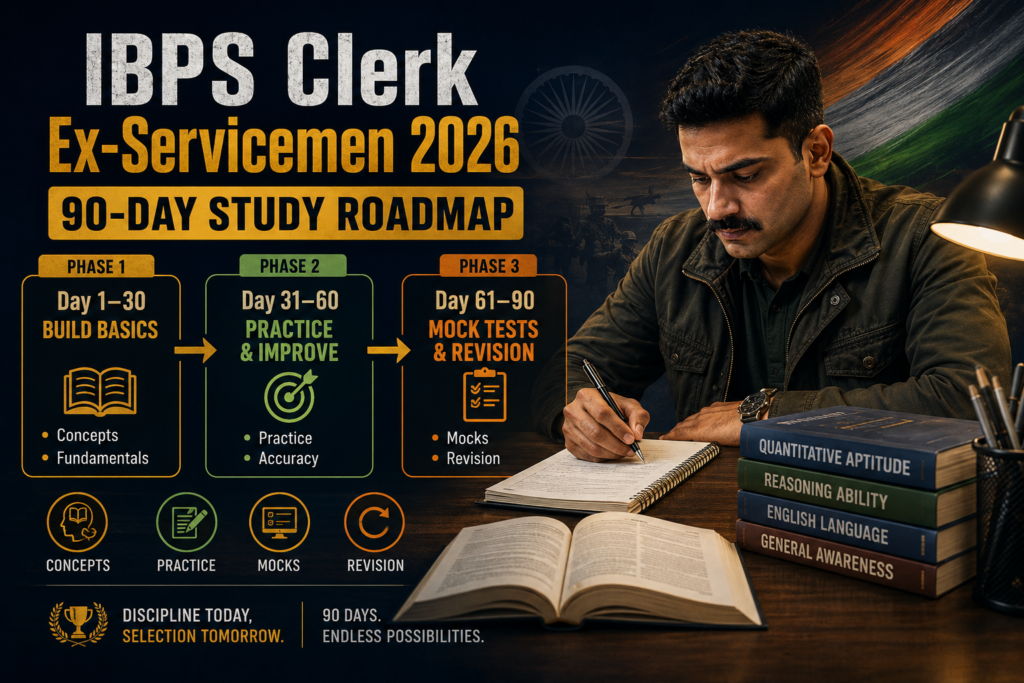
The IBPS Clerk Ex-Servicemen Preparation Strategy 2026 can help candidates restart their banking exam preparation in a systematic way, especially those returning to studies after a long gap.
The right strategy is not about studying for 8–10 hours every day. Candidates need to understand what to study, which topics to prioritize, when to start mock tests and how to improve their weak areas.
IBPS CRP-CSA-XVI recruitment is for the post of Customer Service Associate (CSA), commonly searched by candidates as IBPS Clerk. Ex-Servicemen candidates should prepare seriously for the notified examination while also checking category-specific eligibility, reservation, age relaxation and document requirements.
This article provides a practical 90-day IBPS Clerk study plan for Ex-Servicemen, including subject-wise preparation, mock-test strategy, daily timetable, PYQ strategy, revision plan and important mistakes to avoid.
Quick Preparation Formula
Day 1–30: Build concepts →
Day 31–60: Improve speed and accuracy →
Day 61–90: Attempt mocks, solve PYQs and revise.
IBPS Clerk Ex-Servicemen 2026 Preparation Overview
Candidates can check the important details of the IBPS Clerk Ex-Servicemen 2026 preparation plan below.
| Particular | Details |
|---|---|
| Recruitment | IBPS CRP-CSA-XVI |
| Commonly Known As | IBPS Clerk 2026 |
| Post | Customer Service Associate |
| Category | Ex-Servicemen |
| Preparation Period | 90 Days |
| Exam Mode | Online |
| Recommended Study Time | 3–5 Focused Hours Daily |
| Preparation Formula | Concept → Practice → Mock → Analysis → Revision |
IBPS Clerk 2026 Exam Pattern for Ex-Servicemen
Before preparing any study timetable, candidates should understand the latest examination structure. There is no need to search for a separate Ex-Servicemen question paper; candidates should prepare according to the notified IBPS examination pattern.
IBPS Clerk Prelims Exam Pattern 2026
| Section | Questions | Marks | Time |
|---|---|---|---|
| English Language | 30 | 30 | 20 Minutes |
| Numerical Ability | 35 | 35 | 20 Minutes |
| Reasoning Ability | 35 | 35 | 20 Minutes |
| Total | 100 | 100 | 60 Minutes |
What Does the Prelims Pattern Mean for Your Preparation?
Candidates cannot spend unlimited time on a single section. Therefore, the preparation strategy should focus on:
- Speed
- Accuracy
- Question selection
- Sectional time management
- Regular timed practice
IBPS Clerk Mains Exam Pattern 2026
| Section | Questions | Marks | Time |
|---|---|---|---|
| General/Financial Awareness | 40 | 50 | 20 Minutes |
| General English | 40 | 40 | 35 Minutes |
| Reasoning Ability | 40 | 60 | 35 Minutes |
| Quantitative Aptitude | 40 | 50 | 35 Minutes |
| Total | 160 | 200 | 125 Minutes |
IBPS Clerk Ex-Servicemen 90-Day Study Plan
A 90-day preparation period can be effective if candidates divide their studies into three clear phases instead of trying to complete everything simultaneously.
| Phase | Days | Main Target |
|---|---|---|
| Phase 1 | Day 1–30 | Concepts & Fundamentals |
| Phase 2 | Day 31–60 | Practice, Speed & Accuracy |
| Phase 3 | Day 61–90 | Mocks, PYQs & Revision |
Phase 1: Day 1–30 – Build Strong Fundamentals
The first month is especially important for Ex-Servicemen candidates returning to academic preparation after a long gap.
Do not chase speed from Day 1. First understand the basic method and develop confidence.
Quantitative Aptitude Targets
- Simplification
- Approximation
- Number Series
- Percentage
- Ratio & Proportion
- Average
- Profit & Loss
- Simple Interest
- Compound Interest
- Time & Work
- Time, Speed & Distance
Reasoning Targets
- Inequality
- Syllogism
- Coding-Decoding
- Blood Relation
- Direction Sense
- Order & Ranking
- Alphanumeric Series
- Basic Seating Arrangement
English Targets
- Basic Grammar
- Subject-Verb Agreement
- Tenses
- Articles
- Prepositions
- Error Detection
- Fillers
- Cloze Test
- Daily Reading
Phase 2: Day 31–60 – Improve Speed and Accuracy
Once the basic concepts are clear, candidates should begin mixed and timed question practice.
Quant Focus
- Arithmetic Mixed Questions
- Data Interpretation
- Caselet DI
- Number Series
- Simplification & Approximation
- Timed Calculation Drills
Reasoning Focus
- Linear Seating Arrangement
- Circular Seating Arrangement
- Floor-Based Puzzle
- Box-Based Puzzle
- Month/Date Puzzle
- Mixed Arrangement
English Focus
- Reading Comprehension
- Cloze Test
- Error Detection
- Fillers
- Sentence Rearrangement
- Word Usage
- Para Jumbles
By Day 60, candidates should know not only how to solve a question, but also whether that question is worth attempting during the examination.
Phase 3: Day 61–90 – Mock Tests, PYQs and Revision
The final 30 days should be completely exam-oriented.
- Attempt regular full-length mock tests.
- Practice sectional tests.
- Solve previous-year questions.
- Analyze every incorrect answer.
- Revise formulas regularly.
- Practice weak chapters.
- Improve question selection.
- Revise General and Financial Awareness.
Quantitative Aptitude Preparation Strategy
For many candidates returning to studies after several years, calculation speed may initially be a major challenge.
Do not directly start with difficult Data Interpretation sets. First strengthen basic calculations and Arithmetic.
Important Quant Topics
- Simplification
- Approximation
- Number Series
- Percentage
- Ratio & Proportion
- Average
- Profit & Loss
- Simple and Compound Interest
- Time & Work
- Time, Speed & Distance
- Data Interpretation
Candidates should regularly practice:
- Tables
- Squares
- Cubes
- Fractions
- Fraction-to-percentage conversions
- Percentage calculations
ExamTune Expert Tip: Faster calculations can save valuable time in Simplification, Arithmetic and Data Interpretation. Calculation practice should therefore be daily, not occasional.
Reasoning Ability Preparation Strategy
Reasoning can become one of the highest-scoring sections when candidates understand common question patterns and practice consistently.
Start With Easier Topics
- Inequality
- Syllogism
- Coding-Decoding
- Blood Relation
- Direction Sense
- Order & Ranking
- Alphanumeric Series
Then Move to Puzzles
- Linear Seating Arrangement
- Circular Seating Arrangement
- Floor-Based Puzzle
- Box-Based Puzzle
- Month and Date Puzzle
- Mixed Seating Arrangements
Do not measure your preparation only by the number of questions solved.
Monitor:
Accuracy + Time Taken + Question Selection
English Language Preparation Strategy
Candidates weak in English should not begin by memorizing hundreds of difficult words.
First build a regular reading habit and improve basic grammar.
Important English Topics
- Reading Comprehension
- Error Detection
- Cloze Test
- Fillers
- Sentence Improvement
- Para Jumbles
- Vocabulary in Context
30-Minute English Formula
10 Minutes – Reading
10 Minutes – Grammar
10 Minutes – Exam Questions
Daily consistency is more useful than studying English for several hours only once a week.
General and Financial Awareness Preparation Strategy
Candidates targeting final selection should not wait until Prelims is over to start General and Financial Awareness.
Important Areas
- Current Affairs
- Banking Awareness
- Financial Awareness
- RBI-related Updates
- Government Schemes
- Important Appointments
- Reports and Indexes
- Important National Events
- Important International Events
The biggest problem with Current Affairs is often not learning information—it is retaining it.
Follow:
Read → Revise → Test → Revise Again
Best Daily Study Timetable for Ex-Servicemen
Candidates should prepare a realistic schedule that they can follow consistently.
| Subject / Activity | Suggested Time |
|---|---|
| Quantitative Aptitude | 60 Minutes |
| Reasoning Ability | 60 Minutes |
| English Language | 40 Minutes |
| General/Financial Awareness | 40 Minutes |
| PYQ / Sectional Test / Mock | 60 Minutes |
| Error Revision | 20 Minutes |
Only 3 Hours Available?
Candidates with family, work or other responsibilities can use the shorter timetable below.
| Activity | Time |
|---|---|
| Quant | 45 Minutes |
| Reasoning | 45 Minutes |
| English | 30 Minutes |
| GA | 30 Minutes |
| Test / PYQ | 30 Minutes |
Remember: Three focused hours every day are more useful than an irregular eight-hour study session.

IBPS Clerk Mock Test Strategy for Ex-Servicemen
Mock tests should not be used only to check your score.
Their biggest purpose is to identify why you are losing marks.
| Mistake Type | Problem | Solution |
|---|---|---|
| Concept Error | Concept is unclear | Study the topic again |
| Calculation Error | Method correct but answer wrong | Daily calculation drill |
| Time Error | Question took too long | Timed practice |
| Selection Error | Wrong question attempted first | Improve question selection |
Example of Correct Mock Analysis
Suppose your Quant score is low.
Do not simply say:
“My Maths is weak.”
Instead, identify the exact reason:
- 4 questions missed because calculations were slow.
- 3 questions were wrong due to concept errors.
- 5 questions were left because DI consumed too much time.
- 2 easy questions were missed because of poor question selection.
Now you know exactly what to improve the next day.
Maintain an Error Notebook
After every test, write:
Topic → Mistake → Correct Approach
For example:
Mistake: Used the wrong base value.
Correct Approach: Identify the original/base value before calculating percentage change.
Before your next mock, revise the error notebook for 10–15 minutes.
The objective is simple:
Do not make the same mistake repeatedly.
Weekly Preparation Plan for IBPS Clerk Ex-Servicemen 2026
Candidates can use six days for study and keep one day mainly for revision and testing.
Weekly Revision Day
- Revise Quant formulas.
- Revise calculation techniques.
- Revise English grammar rules.
- Revise Current Affairs.
- Attempt one mock or sectional test.
- Analyze mistakes.
- Identify weak topics.
- Set targets for the next week.
Do not start a new study week without analyzing what improved during the previous week.
Special Preparation Tips for Ex-Servicemen Candidates
For many Ex-Servicemen candidates, the biggest initial challenge may not be the syllabus itself.
It may be getting back into the habit of regular academic study.
During the first 10–15 days, focus on rebuilding:
- Calculation speed
- Daily English reading habit
- Sitting concentration
- Computer-based exam comfort
- Daily study consistency
- Question-solving confidence
Your Discipline Can Become Your Biggest Advantage
The discipline developed during service can become a major strength in competitive examination preparation.
Use the same discipline for:
Study → Practice → Test → Analysis → Revision
Do Not Ignore the Local Language Requirement
Candidates should carefully check the local-language requirements applicable to the State or Union Territory for which they are applying.
Candidates should also verify whether their educational documents and language qualifications satisfy the notified conditions.
Do not wait until the final stage of recruitment to understand these requirements.
How to Use Previous Year Questions Correctly?
Previous Year Questions or PYQs help candidates understand:
- Frequently tested concepts
- Important topics
- Typical question level
- Exam approach
- Easy scoring areas
- Personal weak topics
Best PYQ Strategy:
Learn Topic → Solve Topic-Wise PYQs → Take Sectional Test → Analyze → Revise
IBPS Clerk Ex-Servicemen 2026 Last 15 Days Strategy
The final 15 days are not the right time to collect new books, PDFs, courses and preparation strategies.
During the final days, concentrate mainly on:
- Full-length mock tests
- Sectional tests
- Previous-year questions
- Arithmetic formulas
- Calculation drills
- Puzzle practice
- English grammar revision
- Current Affairs revision
- Error notebook
- Weak-topic revision
10 Common Preparation Mistakes Ex-Servicemen Should Avoid
- Waiting for the entire syllabus to finish before attempting tests.
- Attempting mock tests without analyzing mistakes.
- Studying only favourite subjects.
- Ignoring English preparation.
- Starting General Awareness too late.
- Practicing without a timer.
- Changing books and strategies every few days.
- Ignoring Previous Year Questions.
- Comparing daily mock scores with other candidates.
- Failing to revise already completed topics.
One good strategy followed consistently for 90 days is better than ten strategies followed for only a few days each.
What Should You Do Today?
Do not finish this article and postpone your preparation until tomorrow.
Step 1: Attempt one Prelims-level sectional test or PYQ set.
Step 2: Identify your two weakest areas.
Step 3: Start Day 1 of your 90-day study plan today.
Your first test score does not decide your final result.
It simply tells you where your preparation is starting from.
IBPS Clerk Ex-Servicemen 90-Day Preparation Checklist
Before the examination, candidates should aim to complete the following:
- Important Prelims concepts completed
- Arithmetic practiced regularly
- Calculation speed improved
- Different puzzle types practiced
- Daily English reading habit developed
- General/Financial Awareness covered
- Sectional tests attempted
- Full-length mock tests attempted
- Previous-year questions solved
- Error notebook maintained
- Weak chapters revised
- Sectional timing practiced
- Final revision completed
Recommended IBPS Clerk 2026 Resources
Candidates preparing for IBPS Clerk 2026 can also read these useful ExamTune resources:
- IBPS Clerk 2026 Syllabus and Exam Pattern
- IBPS Clerk Cut Off 2026 and Safe Score
- IBPS Clerk Ex-Servicemen Eligibility and Rules
- IBPS Clerk Salary and Job Profile 2026
Official IBPS Source
Candidates should verify exam pattern, category eligibility, reservation rules, language requirements and other recruitment conditions from the official IBPS notification.
Final Preparation Advice
The IBPS Clerk Ex-Servicemen Preparation Strategy 2026 does not need to be complicated.
For the first 30 days, strengthen your concepts.
For the next 30 days, improve your speed, accuracy and question selection.
For the final 30 days, focus heavily on mock tests, previous-year questions, error analysis and revision.
Do not judge your preparation only by how many hours you spend studying.
Judge it by:
- How many concepts you understand
- How many questions you solve correctly
- How much your mock performance improves
- How many repeated mistakes you eliminate
Ask yourself every seven days:
“Am I better prepared today than I was one week ago?”
Your service gave you discipline. Now use that discipline to build your next career in banking.
Frequently Asked Questions
Is the IBPS Clerk exam different for Ex-Servicemen?
No. The exam pattern is the same, but eligibility, reservation, age relaxation and document rules may differ.
Can an Ex-Serviceman prepare for IBPS Clerk in 90 days?
Yes. With a proper study plan, 90 days can be enough for concepts, practice, mocks, PYQs and revision.
How many hours should I study daily?
Around 3–5 focused hours daily is a practical target.
When should I start mock tests?
Start sectional tests after learning basic concepts. Do not wait for the full syllabus to finish.
What is more important: speed or accuracy?
Both matter, but build accuracy first and then improve speed through timed practice.
Which subject should I prepare first?
Start with your weakest section. Quant basics, Reasoning and daily English practice should begin from Day 1.
Should I prepare for Mains along with Prelims?
Yes. Keep Prelims as the main focus, but continue GA and some Mains-level practice.
How can Ex-Servicemen improve Maths after a long gap?
Start with calculations, percentages, ratios, averages and basic Arithmetic before moving to DI.
Are Previous Year Questions important?
Yes. PYQs help you understand question patterns, important topics and your weak areas.
What should I study in the last 15 days?
Focus on mocks, PYQs, formulas, Current Affairs, error revision and weak topics. Avoid too many new chapters.
Practice free quizzes, mock tests, current affairs and exam-wise preparation resources on ExamTune.