IBPS Clerk Ex-Servicemen Cash Withdrawal Process 2026: Procedure, Verification & Clerk Responsibilities
Quick Overview
Practice free quizzes, mock tests, current affairs and exam-wise preparation resources on ExamTune.
IBPS Clerk ESM Cash Withdrawal Process 2026 PDF
Download the IBPS Clerk Ex-Servicemen Cash Withdrawal Process 2026 PDF to understand withdrawal-slip and cheque verification, CBS processing, cash payment precautions and clerk responsibilities. This is educational study material; actual procedures and transaction limits depend on the employing bank’s current rules.
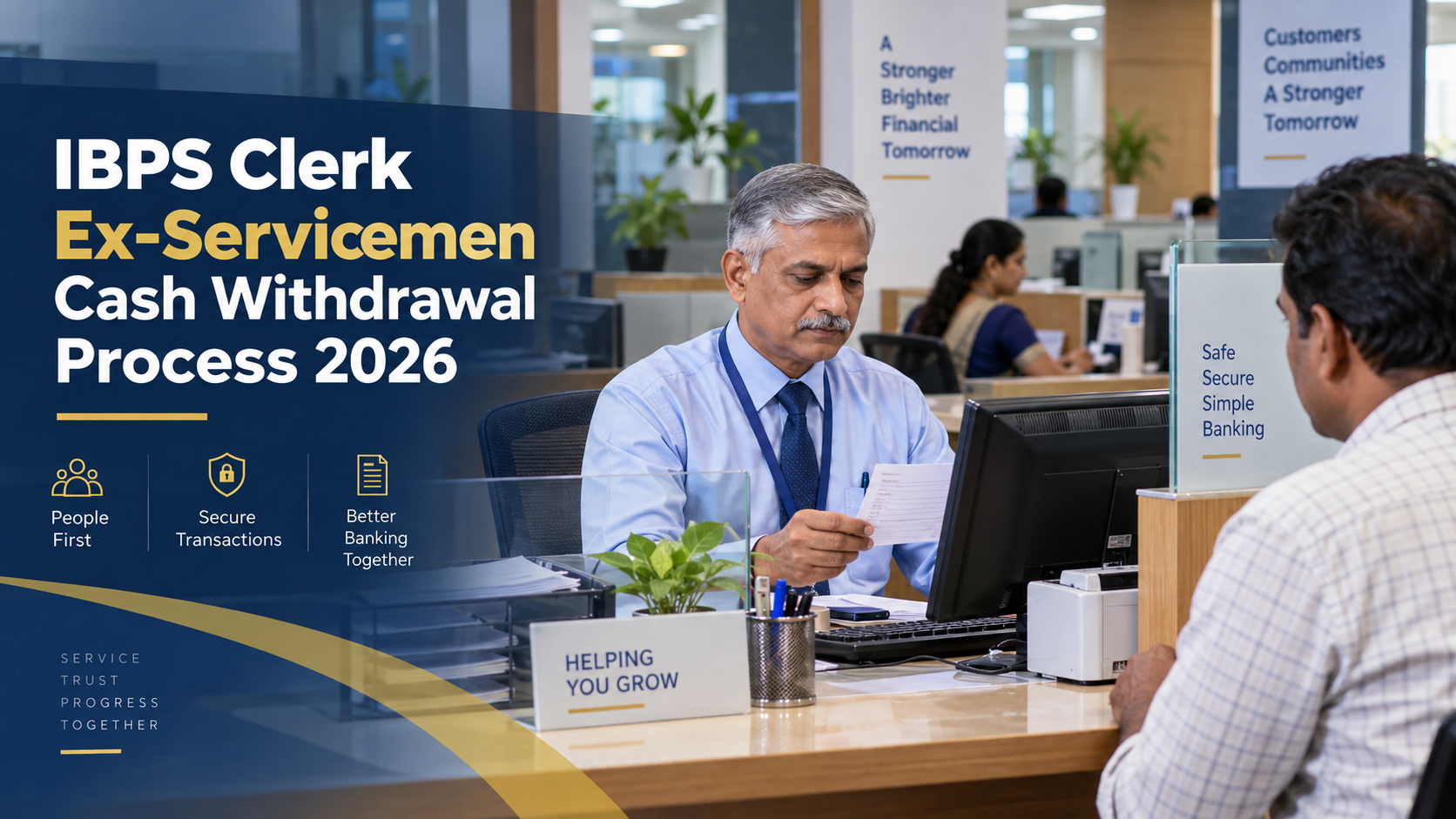
The IBPS Clerk Ex-Servicemen Cash Withdrawal Process 2026 is an important part of branch banking operations. Ex-Servicemen joining as Customer Service Associates should understand how an authorised cash withdrawal request is received, verified, processed and completed according to the participating bank’s rules.
A branch cash withdrawal may be initiated through a cheque, prescribed withdrawal form or another channel permitted for the customer’s account. Before payment, the bank carries out applicable account, instrument, signature, identity, balance and security checks.
This article explains the IBPS Clerk ESM Cash Withdrawal Process 2026, including customer-request documents, verification stages, CBS processing, cash-payment precautions, customer-service responsibilities and common errors to avoid.
Important: This is an educational overview, not an internal operating manual. Exact transaction limits, authorisation levels, security checks and cash-counter duties differ according to the bank, branch, account type and instructions in force.
IBPS Clerk ESM Cash Withdrawal Process Overview
| Particular | Details |
|---|---|
| Recruitment | IBPS Clerk 2026 |
| Official Post Name | Customer Service Associate |
| Candidate Category | Ex-Servicemen |
| Banking Service | Cash Withdrawal |
| Possible Request Methods | Cheque, Withdrawal Form or Approved Banking Channel |
| System Used | Bank’s Authorised Core Banking System |
| Main Requirements | Verification, Accuracy, Confidentiality and Authorisation |
| Final Procedure | As per Employing Bank’s Operational Rules |
What Is a Bank Cash Withdrawal?
A cash withdrawal is a transaction through which an eligible customer obtains money from an account using a channel permitted by the bank. Branch withdrawals may be made through a cheque, prescribed withdrawal form or another approved facility, depending on the account type and bank rules.
Customers may also use ATMs, cash recyclers, authorised cardless facilities or other approved channels. These electronic withdrawals are generally processed automatically and do not normally require an IBPS Clerk to process each transaction manually.
Role of an IBPS Clerk in Cash Withdrawal
A Customer Service Associate may receive, verify or process cash withdrawal requests according to the desk assigned by the branch. A CSA may also perform cash-payment duties when officially assigned and authorised by the bank.
Indicative responsibilities may include:
- Receiving the cheque or prescribed withdrawal form.
- Checking whether the request is complete.
- Verifying account and instrument details.
- Checking the available and withdrawable balance.
- Following applicable signature or identity-verification procedures.
- Processing the transaction through the authorised CBS menu.
- Obtaining additional authorisation where required.
- Making or facilitating cash payment when assigned.
- Maintaining the applicable transaction record.
- Escalating suspicious, incomplete or exceptional transactions.
A clerk must not approve, override or process a transaction beyond the authority assigned by the bank.
Documents Used for Branch Cash Withdrawal
The document requirement depends on the bank, account type, withdrawal method and transaction circumstances. A customer may be required to provide:
- A properly completed withdrawal form, where permitted.
- A valid cheque, where applicable.
- The account passbook where required by the bank.
- Identity or supporting documents when prescribed.
- Additional documents for representatives, mandates or special cases.
A withdrawal form should not automatically be treated as a substitute for a cheque in every account. For example, some banks permit withdrawal forms only for eligible account holders and require the passbook to accompany the form.
Details Checked on a Withdrawal Request
Before processing, the assigned employee should check the information required under the bank’s procedure. This may include:
- Customer or payee name.
- Account number.
- Withdrawal amount in words and figures.
- Date of the request or cheque.
- Customer or drawer signature.
- Material alterations or overwriting.
- Supporting documents, where applicable.
- Validity of the instrument.
An incomplete, materially altered or doubtful request should be handled through the bank’s prescribed exception and escalation procedure.
Step 1: Receiving the Withdrawal Request
The customer presents a cheque, prescribed withdrawal form or other permitted request at the branch. The employee first identifies the type of instrument and checks whether it is allowed for the relevant account and transaction.
The employee should not begin final processing until all required fields and supporting documents are available.
Step 2: Checking the Account and Instrument
The account number and instrument details are checked against the authorised banking system. The employee may need to confirm:
- Whether the account is active and eligible for withdrawal.
- Whether the instrument relates to the correct account.
- Whether the cheque or form is valid under bank rules.
- Whether any applicable account restriction is displayed.
- Whether additional approval or verification is required.
System messages, cautions, holds or restrictions must not be ignored or bypassed.
Step 3: Signature and Identity Verification
The customer’s signature or other permitted authentication is checked according to the bank’s current procedure. A photograph by itself should not be treated as a replacement for the prescribed signature verification process.
Additional customer identification may be required when:
- The signature does not match satisfactorily.
- The instrument contains a material alteration.
- The transaction circumstances are unusual.
- The bank’s risk-based procedure requires additional checks.
- The customer is using a representative or mandate.
- The account contains an operational caution or restriction.
The employee should follow the bank’s approved process instead of creating a personal verification method.
Step 4: Checking the Withdrawable Balance
The account balance is checked through the Core Banking System. The employee must consider the amount currently available for withdrawal rather than relying only on a displayed ledger balance.
The transaction should not proceed when:
- Sufficient withdrawable funds are unavailable.
- The account is blocked, frozen or restricted.
- A lien, hold or operational restriction affects the amount.
- The instrument or request is not valid.
- Required verification or authorisation is incomplete.
The exact reason displayed by the authorised system should be handled according to bank procedure and customer-confidentiality requirements.
Step 5: Processing the Transaction Through CBS
After the preliminary checks are completed, the assigned employee enters or processes the transaction through the bank’s authorised CBS function.
CBS processing may involve:
- Selecting the authorised transaction type.
- Entering the correct account and instrument details.
- Entering the amount accurately.
- Checking system-generated alerts.
- Completing maker-checker or additional authorisation where applicable.
- Confirming that the posting status is successful.
Passwords, authentication credentials and internal processing controls must never be disclosed to customers or unauthorised persons.
Step 6: Cash Payment to the Customer
After all prescribed checks and authorisations are completed, the authorised cash-counter employee prepares the cash for payment. Depending on branch allocation, this employee may be a Customer Service Associate assigned to cash duties.
The cash-payment stage generally includes:
- Confirming that the transaction is authorised and successfully processed.
- Counting the cash accurately.
- Checking the denomination and physical condition of notes.
- Following the bank’s procedure for customer acknowledgement.
- Handing over cash securely to the correct recipient.
- Completing the required transaction record.
Customers should be encouraged to count the cash before leaving the counter, subject to the branch’s applicable procedure.
Step 7: Transaction Completion and Record Maintenance
After payment, the assigned employee should ensure that the transaction is completed in the banking system and the required record is maintained.
The employee may need to:
- Confirm the final CBS transaction status.
- Complete the required stamp or acknowledgement.
- Place the instrument in the prescribed record flow.
- Maintain applicable cash or transaction records.
- Report any difference or irregularity immediately.
A transaction should not be treated as complete solely because cash has been counted. System posting and prescribed documentation must also be completed.
Cash Withdrawal Through a Withdrawal Form
A withdrawal form may be used only where permitted by the bank and the customer’s account conditions. Some banks require the account holder to appear personally and present the passbook when using a withdrawal form.
The employee should verify:
- Whether a withdrawal form is allowed for the account.
- Whether the account holder’s personal presence is required.
- Whether the passbook must accompany the form.
- Whether the requested amount is within the applicable limit.
- Whether all signature and identity requirements are satisfied.
Withdrawal-form limits and conditions differ between banks, account products and home or non-home branches. Therefore, one bank’s public limit should not be presented as a universal IBPS rule.
Cash Withdrawal Through a Cheque
A cash withdrawal may also be requested through an eligible self or bearer cheque. The assigned employee should check the instrument according to the bank’s cheque-payment procedures.
Applicable checks may include:
- Date and validity of the cheque.
- Amount in words and figures.
- Drawer’s signature.
- Material alterations.
- Crossing or other instructions on the cheque.
- Stop-payment or account restrictions.
- Available and withdrawable balance.
- Required customer or presenter verification.
A self or bearer cheque should be handled using the bank’s usual precautions and risk-based procedures. The presence of the account holder should not be imposed as a universal requirement where applicable banking directions provide otherwise.
ATM and Other Cash Withdrawal Channels
Customers may withdraw cash using ATMs, cash recyclers and approved cardless facilities. Availability, per-transaction limits and daily limits depend on the bank, debit-card variant, account type and channel.
Common advantages include:
- Availability beyond normal branch hours.
- Faster routine cash withdrawals.
- Reduced dependence on branch counters.
- Immediate electronic transaction status.
- Access through approved cardless facilities where provided.
ATM withdrawals are normally system-driven. Branch staff primarily assist with complaints, failed transactions, card issues or service guidance according to the bank’s customer-service process.
Special Withdrawal Situations
Some transactions require additional care and a prescribed bank procedure. These may involve:
- Customers unable to sign.
- Customers unable to visit the branch because of illness or disability.
- Thumb-impression-based requests.
- Mandate holders or authorised representatives.
- Joint accounts.
- Minor accounts.
- Deceased or restricted accounts.
- Unusually large or suspicious transactions.
The employee must not improvise documentation or authentication. Such cases should be referred to the authorised officer and handled according to current bank and regulatory instructions.
Common Errors to Avoid
- Entering the wrong account number or amount.
- Ignoring a signature mismatch.
- Missing an alteration on the cheque or form.
- Processing a transaction despite a system restriction.
- Using an incorrect CBS transaction type.
- Paying cash before completing required authorisation.
- Counting or recording cash incorrectly.
- Disclosing customer information.
- Ignoring suspicious transaction indicators.
- Failing to complete the prescribed record.
Safety and Confidentiality Measures
Cash withdrawal work requires operational discipline and protection of customer information.
- Use only authorised CBS credentials and devices.
- Never share passwords or authentication details.
- Lock the workstation when leaving the desk.
- Keep cheques, withdrawal forms and cash secure.
- Discuss account details only with authorised persons.
- Follow the bank’s cash-retention and counter-security procedures.
- Report suspicious activity or a cash difference immediately.
- Do not disclose internal approval limits or security controls publicly.
Customer Service During Cash Withdrawal
The employee should provide clear and respectful assistance without weakening security or bypassing the bank’s procedure.
- Explain missing information politely.
- Avoid discussing account balances loudly.
- Provide realistic processing timelines.
- Give special assistance according to applicable bank policy.
- Escalate complaints through the authorised channel.
- Never promise payment before verification is complete.
Read the IBPS Clerk Ex-Servicemen Customer Handling Guide for detailed customer-service tips.
Tips for Ex-Servicemen Joining as IBPS Clerks
Discipline, vigilance and attention to detail developed during defence service can be useful in branch banking. However, every employee must complete bank-specific training before independently handling transactions.
- Learn the authorised CBS functions carefully.
- Understand your assigned transaction and approval limits.
- Follow the bank’s maker-checker process.
- Never bypass a warning or restriction.
- Use a verification checklist approved by the bank.
- Ask an authorised senior when a case is unclear.
- Maintain polite and confidential customer communication.
- Report mistakes immediately instead of attempting an unauthorised correction.
Employees can also read the IBPS Clerk Ex-Servicemen Work Culture Guide to understand the wider branch environment and professional responsibilities.
Official Cash Withdrawal Resources
- SBI Savings Bank Rules
- Indian Banks’ Association Model Citizen Charter
- RBI Master Circular on Customer Service
IBPS Clerk ESM Cash Withdrawal Process 2026: Conclusion
The IBPS Clerk Ex-Servicemen Cash Withdrawal Process 2026 requires careful verification, accurate CBS processing, proper authorisation, secure cash handling and protection of customer information.
A Customer Service Associate may receive, verify, process or pay a withdrawal transaction depending on the duties officially assigned by the bank. Ex-Servicemen should apply their discipline and attention to detail while following current bank procedures, regulatory instructions and authorised escalation channels.
Popular Online Live Classes

Ex-Servicemen IBPS Clerk 2026 Parakram Batch | IBPS Clerk Pre + Mains Course

Complete Quant Nayak Subscription For All Banking & Insurance Exams 2026-27

Bank Maha Pack | Complete Subscription for IBPS, RRB & SBI Exams 2026-27
Frequently Asked Questions
What is the IBPS Clerk cash withdrawal process?
The process generally includes receiving the withdrawal request, checking the instrument and account details, verifying the signature or identity where required, checking the withdrawable balance, processing the transaction in CBS and making secure cash payment after applicable authorisation.
What documents may be required for cash withdrawal at a bank branch?
Depending on the bank and account type, a customer may need a cheque or withdrawal form, passbook and valid identity proof where required. Exact documentation and limits are determined by the concerned bank.
What is the role of an IBPS Clerk during cash withdrawal?
An authorised clerk may receive and verify the withdrawal request, check account information, process or verify the CBS entry, obtain required approval, assist the customer and complete transaction records.
Does every IBPS Clerk directly pay cash to customers?
No. Cash payment duties depend on the employee’s assigned role, branch requirements, delegated authority and the bank’s internal operating procedures.
What details are checked on a withdrawal slip?
The clerk generally checks the account number, customer name, date, amount in figures and words, signature, alterations, document completeness and any additional requirement prescribed by the bank.
Why is signature verification important?
Signature verification helps confirm that the withdrawal request has been authorised by the account holder. A mismatch or suspicious alteration must be handled according to the bank’s escalation procedure.
What is checked in CBS before processing a withdrawal?
The clerk may check account status, withdrawable balance, holds, liens, restrictions, transaction history alerts and applicable authorisation requirements, subject to the bank’s system and procedures.
Is the passbook compulsory for every branch withdrawal?
Not necessarily. Passbook requirements vary according to the withdrawal method, account type and individual bank rules. Employees should follow their bank’s latest product and operating instructions.
What should a clerk do when a withdrawal transaction appears suspicious?
The transaction should not be processed casually. The clerk should follow the bank’s verification and escalation procedure and inform the authorized officer without disclosing confidential information.
Are cash withdrawal limits the same in every Public Sector Bank?
No. Withdrawal limits, supporting documents, maker-checker requirements and approval levels can vary by bank, account type, channel and branch authority. The latest rules of the employing bank must be followed.
About the Author

Practice free quizzes, mock tests, current affairs and exam-wise preparation resources on ExamTune.