IBPS Clerk Ex-Servicemen Medical Benefits 2026
Quick Overview
Practice free quizzes, mock tests, current affairs and exam-wise preparation resources on ExamTune.
IBPS Clerk Ex-Servicemen Medical Benefits 2026 PDF
Download ExamTune’s guide to medical aid, family eligibility, reimbursement and ECHS rules. Benefits depend on the allotted bank’s policy.
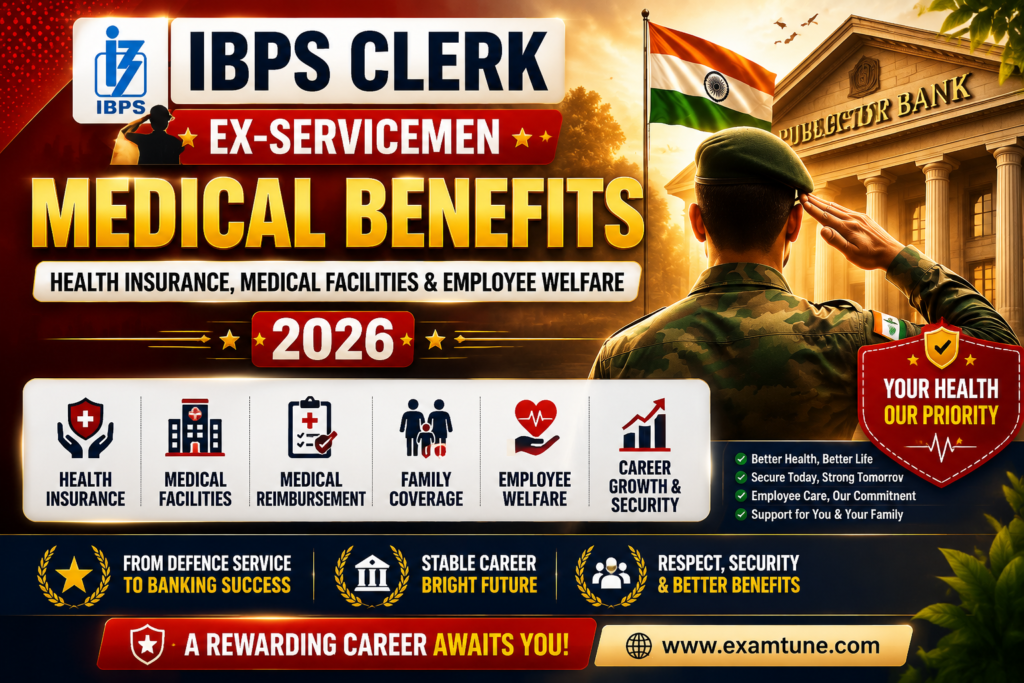
IBPS Clerk Ex-Servicemen Medical Benefits 2026 include the medical facilities available to eligible employees after joining their allotted Public Sector Bank as a Customer Service Associate (Clerk). These may include annual medical aid, hospitalization cover, reimbursement and support for eligible family members.
IBPS conducts the recruitment process; the employing bank administers employee medical benefits. Your entitlement depends on the applicable service settlement, bank circulars and medical scheme or insurance policy. Selection or provisional allotment alone does not activate employee health coverage.
For Ex-Servicemen, another essential question is how bank medical benefits interact with the Ex-Servicemen Contributory Health Scheme (ECHS). Check the applicable option and declaration requirements before using a new employer’s medical facility.
IBPS Clerk Ex-Servicemen Medical Benefits Overview
| Particular | Details |
|---|---|
| Exam Name | IBPS Clerk 2026 / Customer Service Associate recruitment |
| Post | Customer Service Associate (Clerk) |
| Category | Ex-Servicemen joining the bank as employees |
| Organization | The allotted participating Public Sector Bank |
| Medical Benefits | Applicable settlement provisions, bank service rules and medical scheme |
| Health Coverage | Check the employee category, policy period, insured amount and exclusions |
| Family Coverage | Eligible family members subject to the scheme’s definition and enrolment requirements |
| ECHS Coordination | Confirm the applicable medical-facility option with bank HR and the ECHS Regional Centre |
| Official Source | Employing bank’s HR circulars and policy documents; ECHS directions for ECHS matters; IBPS for recruitment |
Are Ex-Servicemen Eligible for Medical Benefits After Joining IBPS Clerk?
Ex-Servicemen appointed as clerical employees can receive the medical benefits applicable to their employment category, subject to the bank’s rules and any relevant ECHS option requirements. Ask HR to confirm the effective coverage date and complete the required employee and family declarations.
Recruitment concessions for Ex-Servicemen do not, by themselves, establish a separate or unlimited bank medical package. Also, retirement from the Armed Forces does not make a newly appointed clerk a retired bank employee. Read the scheme for serving bank staff when checking benefits after joining.
Types of Medical Benefits Available for IBPS Clerk Employees
Different medical facilities serve different purposes. Check each entitlement separately instead of treating every medical expense as an insurance claim.
- Annual medical aid: Limited reimbursement under the applicable service settlement and bank procedure.
- Hospitalization cover: Eligible treatment expenses under the bank’s medical or group insurance scheme.
- Cashless treatment: An approved claim route where the hospital receives the admissible payment directly.
- Reimbursement: Repayment of admissible expenses after submitting the required claim documents.
- Family medical support: Benefits for eligible, enrolled family members.
- Preventive health facilities: Check-ups or welfare facilities implemented under the applicable bank scheme.
A cashless facility and reimbursement are ways of settling eligible expenses; they do not automatically create two separate coverage limits.
Health Insurance Benefits for IBPS Clerk Ex-Servicemen
Read the policy schedule for clerical or award staff, along with its terms and endorsements. Confirm the sum insured, whether it is shared by the family, and whether any additional cover requires a separate option or contribution.
Bank-specific example: Bank of Baroda’s Employees GHI Base Policy 2025–26 specifies ₹4 lakh per family for clerical/award staff on a family floater basis. This is an example from a defined bank policy, not a guaranteed amount for every IBPS recruit or future policy period. See the Bank of Baroda employee base policy.
Before relying on coverage, ask HR or the insurer:
- Which employee and family members are enrolled?
- What are the room, ICU and procedure-specific limits?
- How are pre-existing illnesses, maternity and day-care procedures covered?
- Are OPD consultations, regular medicines or specified domiciliary treatments included?
- Who administers claims, and where is the hospital network list?
Routine OPD care and hospitalization are different benefits. Do not assume that a hospital insurance card pays for every consultation, test, medicine or annual health check-up.
Medical Reimbursement Facility
Annual medical aid: Clause 25 of the 12th Bipartite Settlement for workmen employees specifies medical-expense reimbursement up to ₹2,830 per annum under the medical aid scheme. This is separate from hospitalization coverage. Check the bank’s implementing circular for eligibility, submission requirements and any subsequent revision.
Hospitalization reimbursement: Use the claim procedure prescribed for the bank’s medical scheme. A practical sequence is:
- Confirm the claim route: Ask whether the expense belongs under annual medical aid, insurance or another approved facility.
- Check notification requirements: Obtain the planned-admission and emergency-intimation instructions.
- Collect the records: Keep prescriptions, itemized bills, payment receipts, reports and the discharge summary.
- Submit correctly: Use the specified HR portal, insurer or Third-Party Administrator (TPA), within the applicable deadline.
- Keep an acknowledgement: Save the claim number, submission date and copies of the documents.
- Resolve queries: Supply missing information and check the settlement statement for deductions.
Ask for the policy clause and written reason if a claim is reduced or rejected. Follow the bank’s or insurer’s escalation process where clarification is needed.
Hospitalization Benefits
Hospitalization support may include eligible admission, treatment, procedure and associated expenses. The amount payable depends on the applicable cover and limits.
For cashless treatment, confirm the hospital’s eligibility and obtain the required authorization. Cashless approval does not mean every charge is payable: excluded items and expenses beyond approved limits may remain payable by the patient. A refused cashless request does not necessarily decide the reimbursement claim; admissibility is assessed under the policy.
For planned treatment, keep these questions ready:
- Is the proposed hospital eligible under my scheme?
- Which room category is within my entitlement?
- Does the estimated procedure cost exceed any specific limit?
- What records and approvals will be needed at discharge?
Family Medical Benefits
Family coverage depends on the scheme’s definition of an eligible family member and the details recorded during enrolment. Typical categories to check include the spouse, dependent children and eligible dependent parents or parents-in-law.
Clause 29 of the 12th Bipartite Settlement sets a monthly income ceiling of ₹18,000 for a wholly dependent family member. For parents, their combined monthly income is relevant. The settlement permits any two eligible dependent parents/parents-in-law for medical reimbursement. Apply these provisions through the bank’s policy and enrolment process.
- Check the applicable income, relationship and other dependency conditions.
- Provide the prescribed family and dependency declarations.
- Check names, dates of birth and relationships on the coverage record.
- Ask how and when marriage, childbirth or changes in dependency should be reported.
- Disclose a spouse’s employment and other medical facilities where required.
ECHS and bank schemes have their own eligibility rules. Inclusion under one scheme does not establish eligibility under the other.
Difference Between Defense Medical Benefits and Bank Medical Benefits
| Defense Medical Benefits | Bank Medical Benefits |
|---|---|
| Governed by the relevant defence medical scheme; ECHS applies to eligible enrolled beneficiaries | Governed by the bank’s applicable service rules, settlement and medical policy |
| ECHS services operate through its prescribed medical and referral arrangements | Services operate through the bank’s approved medical or insurance arrangements |
| Family eligibility follows the applicable defence scheme | Family eligibility follows the bank scheme and enrolment requirements |
| ECHS option and safe-custody requirements may apply when taking another government/PSU medical facility | HR should confirm the declarations required from an ECHS member |
ECHS after joining a Public Sector Bank: ECHS’s safe-custody policy states that an Ex-Serviceman taking employment with a government organization or PSU providing medical facilities can avail the medical facility of only one government agency. It provides for temporary exit from ECHS and electronic blocking of the member’s cards when opting for the new employer’s facility. See the official ECHS safe-custody policy.
Confirm its application to your bank scheme with HR and your ECHS Regional Centre before exercising an option. The prescribed process involves a request to the Regional Centre; the safe-custody acknowledgement can serve as an NOC. Returning to ECHS requires the prescribed unblocking process and employer NOC.
ECHS separately addresses personally subscribed mediclaim insurance: its official FAQ, Question 71, permits a residual-expense claim after insurance settlement, subject to the rules and total actual expenditure. Do not assume that this provision overrides the government/PSU employment option rule. The same expense must not be reimbursed twice.
Medical Benefits During Probation Period
Check the coverage start date in the appointment and medical policy documents. Probation alone should not be treated as proof that medical insurance begins only after confirmation.
For example, the Bank of Baroda policy linked above provides coverage for new employees from their joining date as stated in the appointment letter. Confirm the provision applicable to your own bank.
- Obtain written confirmation of the effective coverage date.
- Complete employee and eligible-family enrolment promptly.
- Confirm how to obtain the policy or health-card details.
- Ask how claims are handled if treatment occurs before the card is issued.
- Complete any applicable ECHS option or NOC process.
Important Documents Required for Medical Claims
Use the checklist for your specific claim. Documents commonly requested include:
- Completed claim form and employee or policy identification details.
- Patient identification and relationship details for a family claim.
- Doctor’s prescriptions and relevant investigation reports.
- Itemized hospital bills, pharmacy bills and payment receipts.
- Admission record and discharge summary for hospitalization.
- Referral, authorization or emergency documents, where required.
- Account details for reimbursement, if requested.
- Other-insurance settlement records or ECHS-related declarations/NOC, where applicable.
Keep readable copies before submitting originals. Check whether the claim requires physical documents, digital submission or both.
Important Guidelines for Ex-Servicemen Employees
- Read the correct scheme: Use the medical policy for serving staff and your employment category.
- Separate the benefits: Annual medical aid, hospitalization insurance and optional additional cover have different purposes.
- Verify family eligibility: Confirm dependency conditions and completed enrolment.
- Resolve ECHS coordination: Obtain the applicable option and NOC instructions before using the employer facility.
- Save claim contacts: Keep HR, insurer/TPA and hospital insurance-desk details accessible.
- Follow deadlines: Check notification and document-submission requirements for the particular scheme.
- Retain records: Keep claim acknowledgements, settlement statements and correspondence.
Conclusion
IBPS Clerk Ex-Servicemen Medical Benefits 2026 should be understood through the employing bank’s service rules and medical policy. Annual medical aid, hospitalization support and eligible-family benefits are distinct entitlements. After joining, confirm coverage, complete enrolment and understand the claim procedure. ECHS members should also resolve the applicable medical-facility option with bank HR and their ECHS Regional Centre.
Popular Online Live Classes
Ex-Servicemen IBPS Clerk 2026 Parakram Batch | IBPS Clerk Pre + Mains Course
Bank Clerk Target Batch 2026 | SBI, IBPS & RRB Assistant (Nirman 2.0) Course
Frequently Asked Questions
What are IBPS Clerk Ex-Servicemen Medical Benefits?
These are the medical facilities available to eligible Ex-Servicemen after joining their allotted Public Sector Bank. Benefits may include annual medical aid, hospitalization cover, reimbursement and eligible-family coverage, subject to the bank’s rules.
Does IBPS provide medical insurance directly to selected candidates?
IBPS handles recruitment and provisional allotment. The employing bank administers employee medical benefits. Selection alone does not activate medical coverage; the applicable joining date, enrolment requirements and policy conditions must be checked.
How much annual medical aid is available to bank clerical employees?
Clause 25 of the 12th Bipartite Settlement specifies medical-expense reimbursement up to ₹2,830 per annum under the medical aid scheme. This is separate from hospitalization insurance. Employees should check the bank’s implementing circular and any subsequent revision.
Is health insurance coverage the same in every participating bank?
Employees should verify the coverage applicable to their bank, staff category and policy period. A coverage amount mentioned in one bank’s policy should not be treated as a guaranteed entitlement for every IBPS Clerk recruit.
Are family members covered under bank medical benefits?
Eligible family members may be covered after meeting the scheme’s relationship, dependency and enrolment requirements. Check the rules for the spouse, dependent children, parents or parents-in-law and other specified dependents before submitting their details.
Are medical benefits available during the probation period?
Coverage during probation depends on the applicable bank rules and policy. Do not assume that insurance starts only after confirmation. Ask HR to confirm the effective coverage date and complete employee and family enrolment promptly.
How can an employee claim cashless hospitalization?
Confirm the hospital’s eligibility under the policy and arrange the required authorization through the hospital and insurer or Third-Party Administrator. Follow the notification requirements. Excluded charges and expenses beyond approved limits may remain payable by the employee.
Which documents are required for medical reimbursement?
Common documents include the claim form, employee or policy identification, prescriptions, investigation reports, itemized bills, payment receipts and discharge summary. Family claims may require relationship details. Follow the specific scheme’s checklist and submission deadline.
Can an Ex-Serviceman use ECHS and bank medical facilities simultaneously?
Do not assume both facilities can be used simultaneously. ECHS has an option and temporary-exit procedure for government or PSU employment providing medical facilities. Confirm its application with bank HR and the ECHS Regional Centre before using the employer’s facility.
Does hospitalization insurance cover every OPD consultation and medicine?
Hospitalization coverage does not automatically include every outpatient consultation, test or regular medicine. Check whether the expense is covered under OPD benefits, specified domiciliary treatment, annual medical aid or another approved bank facility.
About the Author

Practice free quizzes, mock tests, current affairs and exam-wise preparation resources on ExamTune.