
IBPS Clerk Ex-Servicemen Cheque Clearing Process 2026: CTS, Verification & Clerk Responsibilities
Quick Overview
Practice free quizzes, mock tests, current affairs and exam-wise preparation resources on ExamTune.
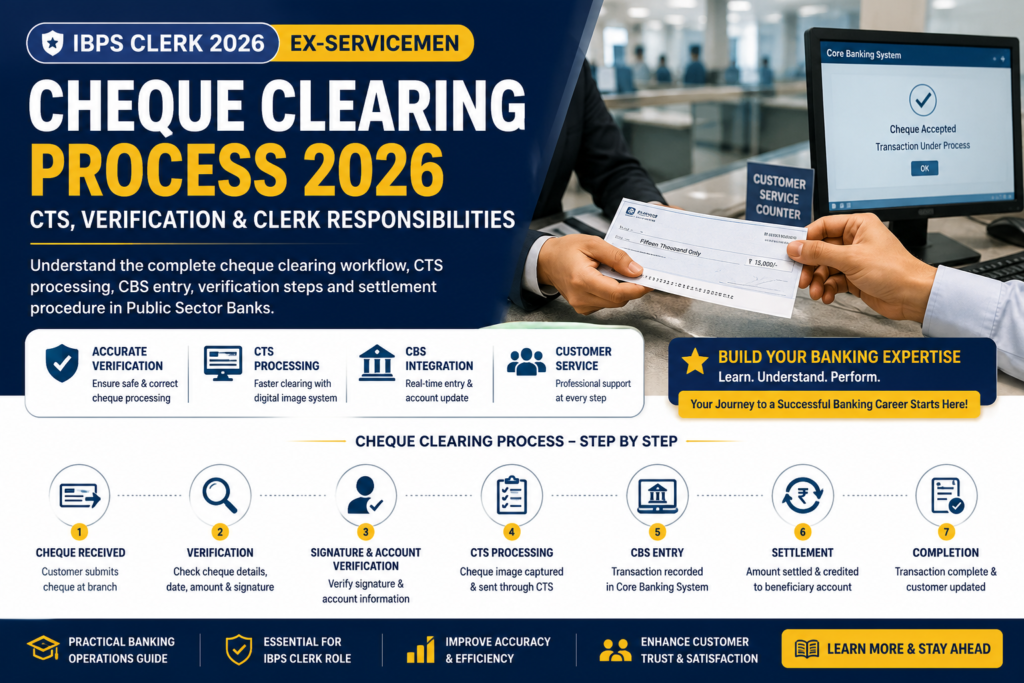
The IBPS Clerk Ex-Servicemen Cheque Clearing Process 2026 is an important banking operation that every newly appointed IBPS Clerk should understand. Even though digital banking has increased, cheque transactions continue to play an important role in Public Sector Banks. Ex-Servicemen joining as IBPS Clerks should know how cheques are verified, processed, and cleared through modern banking systems.
Cheque clearing involves verifying the cheque, checking customer account details, processing it through the Cheque Truncation System (CTS), and updating records in the Core Banking System (CBS). Accuracy and careful verification are essential throughout the process.
This article explains the complete IBPS Clerk Ex-Servicemen Cheque Clearing Process 2026, including cheque verification, CTS processing, CBS entry, settlement procedure, and the responsibilities of an IBPS Clerk.
IBPS Clerk Ex-Servicemen Cheque Clearing Overview
| Particular | Details |
|---|---|
| Exam Name | IBPS Clerk 2026 |
| Post | Customer Service Associate (Clerk) |
| Category | Ex-Servicemen |
| Banking Process | Cheque Clearing |
| Main System Used | CTS & Core Banking System (CBS) |
| Main Responsibility | Cheque Verification & Processing |
What is Cheque Clearing?
Cheque clearing is the banking process through which the amount mentioned on a cheque is verified and transferred from the payer’s account to the payee’s account after successful verification.
Today, most Public Sector Banks use the Cheque Truncation System (CTS) for faster and safer cheque processing.
Types of Cheques Handled by an IBPS Clerk
An IBPS Clerk may deal with different types of cheques during daily banking operations.
- Bearer Cheque
- Order Cheque
- Crossed Cheque
- Account Payee Cheque
- Self Cheque
Role of an IBPS Clerk in Cheque Clearing
IBPS Clerks play an important role in ensuring that cheque transactions are processed safely and accurately according to the bank’s operational guidelines.
- Receive cheque from customer.
- Verify cheque details.
- Check customer information.
- Process cheque through CTS.
- Update transaction in CBS.
- Assist customers during the clearing process.
Documents Required During Cheque Submission
Depending on the type of transaction and bank procedure, customers may be required to provide:
- Original cheque.
- Deposit slip (where applicable).
- Valid account details.
- Identity proof (if required).
Step 1: Customer Submits the Cheque
The customer submits the cheque at the bank branch for collection or clearing. The cheque is checked for basic completeness before further processing.
Step 2: Cheque Verification
The IBPS Clerk carefully verifies all important information printed on the cheque before processing it.
- Cheque number.
- Date.
- Payee name.
- Amount in words and figures.
- Drawer’s signature.
- Bank branch details.
Step 3: Signature Verification
The customer’s signature is verified according to the bank’s records. If any mismatch or irregularity is found, the cheque may require further verification according to the bank’s procedures.
Step 4: Account Verification
The account details and transaction information are verified through the Core Banking System (CBS) before forwarding the cheque for clearing.
Step 5: Cheque Truncation System (CTS) Processing
After successful verification, the cheque is processed through the Cheque Truncation System (CTS). CTS enables faster cheque clearing by processing cheque images electronically instead of physically moving paper cheques between banks.
Conclusion
The IBPS Clerk Ex-Servicemen Cheque Clearing Process 2026 is an important banking operation that requires careful verification, proper documentation, and accurate transaction processing. Understanding cheque handling, CTS, and CBS helps Ex-Servicemen candidates perform banking duties efficiently after joining a Public Sector Bank.
Step 6: Core Banking System (CBS) Entry
After successful cheque verification and CTS processing, the transaction details are updated in the Core Banking System (CBS). CBS maintains the customer account records and helps complete the cheque clearing process accurately.
CBS records generally include:
- Cheque number.
- Account details.
- Transaction amount.
- Transaction date.
- Clearing status.
Step 7: Settlement & Cheque Clearing
Once the clearing process is completed successfully, the cheque amount is settled according to the banking system and credited to the eligible customer’s account as per applicable clearing timelines.
After settlement:
- Transaction is completed.
- Customer account is updated.
- CBS records are maintained.
- Customer can verify the transaction through banking channels.
What is Cheque Truncation System (CTS)?
The Cheque Truncation System (CTS) is an image-based cheque clearing system used by banks to speed up the cheque clearing process. Instead of physically transporting cheques between banks, digital images of cheques are processed electronically.
Major benefits of CTS include:
- Faster cheque clearing.
- Reduced paperwork.
- Improved transaction security.
- Lower processing time.
- Better operational efficiency.
Reasons Why a Cheque May Be Returned
A cheque may not be processed successfully if certain verification requirements are not fulfilled.
- Insufficient account balance.
- Signature mismatch.
- Incorrect cheque details.
- Overwriting or alterations.
- Expired or stale cheque.
- Damaged cheque.
- Technical verification issues.
Common Mistakes During Cheque Processing
IBPS Clerks should carefully avoid mistakes while processing cheque transactions.
- Incorrect data entry in CBS.
- Failure to verify signatures.
- Ignoring cheque date.
- Not checking account details.
- Incomplete document verification.
- Processing damaged cheques without proper verification.
Responsibilities of an IBPS Clerk During Cheque Clearing
An IBPS Clerk is responsible for ensuring that every cheque is processed accurately while following the bank’s operational guidelines.
- Verify cheque details carefully.
- Maintain customer confidentiality.
- Process transactions through CBS.
- Follow CTS procedures.
- Assist customers professionally.
- Report discrepancies to senior officials whenever required.
Tips for Ex-Servicemen Candidates
Ex-Servicemen already possess discipline and attention to detail, which are valuable qualities for cheque verification and banking operations.
- Learn cheque verification procedures thoroughly.
- Practice using Core Banking System (CBS).
- Understand CTS workflow.
- Improve banking terminology knowledge.
- Always follow official banking guidelines.
- Maintain accuracy while processing transactions.
Conclusion
The IBPS Clerk Ex-Servicemen Cheque Clearing Process 2026 is an essential part of modern banking operations. Proper understanding of cheque verification, CTS processing, CBS entry, and settlement procedures enables Ex-Servicemen candidates to perform cheque-related banking services efficiently while maintaining accuracy, security, and excellent customer service.
Frequently Asked Questions
What is cheque clearing in banking?
Cheque clearing is the process through which a cheque is verified, processed, and settled so that the amount is transferred to the eligible account
What is the role of an IBPS Clerk in cheque clearing?
An IBPS Clerk verifies cheque details, checks signatures, processes the cheque through CTS and CBS, and assists customers during the clearing process
What is the Cheque Truncation System (CTS)?
CTS is an image-based cheque clearing system that processes cheque images electronically instead of physically transporting paper cheques between banks.
Why is signature verification important in cheque clearing?
Signature verification helps confirm that the cheque has been issued by the authorized account holder and supports secure banking transactions.
What are the common reasons for cheque return?
Common reasons include insufficient balance, signature mismatch, incorrect cheque details, overwriting, stale cheque, or damaged cheque.
How does CBS help in cheque clearing?
CBS records cheque transactions, verifies account details, updates customer accounts, and supports accurate processing of cheque settlements
Do Ex-Servicemen receive cheque clearing training after joining?
Yes, newly joined Ex-Servicemen receive practical training on cheque verification, CTS, CBS operations, and customer service procedures.
What documents are generally required for cheque submission?
Customers generally submit the original cheque, relevant account details, deposit slip where applicable, and any additional documents required by the bank.
How can an IBPS Clerk avoid mistakes during cheque processing?
By carefully verifying cheque details, checking signatures, following CTS procedures, entering accurate data in CBS, and complying with bank guidelines.
Where can candidates learn cheque clearing procedures before joining?
Candidates can study banking operations through exam preparation material, while practical cheque clearing training is generally provided by the allotted Public Sector Bank after joining.
Practice free quizzes, mock tests, current affairs and exam-wise preparation resources on ExamTune.