IBPS Clerk Ex-Servicemen Success Tips 2026: How to Crack the Exam
Quick Overview
Practice free quizzes, mock tests, current affairs and exam-wise preparation resources on ExamTune.
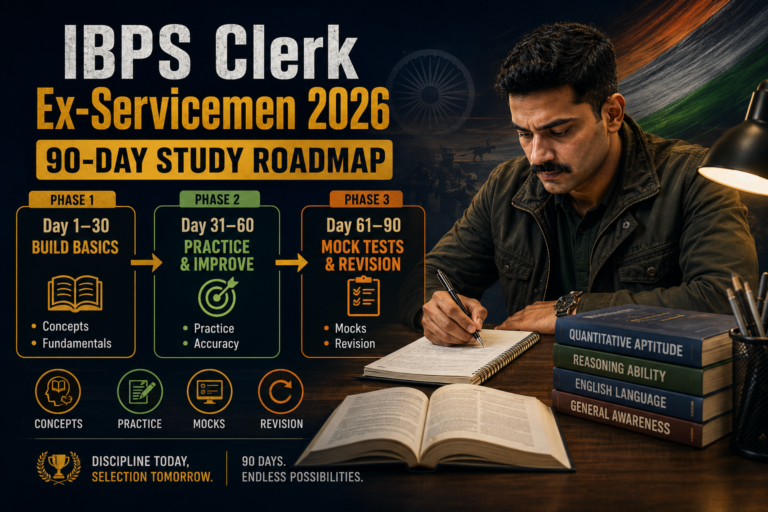
IBPS Clerk ESM Preparation Plan 2026 PDF
Includes a 90-day roadmap, a date-specific short plan and mock-analysis checklist. Adapt the schedule to your available time. An ExamTune resource, not an IBPS notification.

The IBPS Clerk ESM Success Tips in this guide focus on rebuilding basic concepts, practising consistently and improving performance through mock-test analysis. ESM means Ex-Servicemen. For candidates restarting competitive-exam preparation after military service, the most useful first step is to identify their current strengths and weaknesses.
IBPS Clerk recruitment is conducted for the Customer Service Associate (CSA) post. Prepare according to the applicable recruitment notification rather than assuming that Ex-Servicemen candidates receive a separate, easier examination.
This guide brings together practical IBPS Clerk Preparation Tips for Ex-Servicemen, including a daily timetable, subject-wise practice, an error-analysis method and a final-month revision framework. Study hours and practice targets below are suggested routines, not official requirements or guarantees of selection.
IBPS Clerk ESM Success Tips Overview
| Particular | Details |
|---|---|
| Exam Name | IBPS Clerk / CSA 2026 |
| Recruitment Process | CRP CSA-XVI |
| Post | Customer Service Associate |
| Guide For | Ex-Servicemen preparing for Prelims and Mains |
| Preparation Duration | Suggested planning window: 90–120 days, adapted to your starting level and available time |
| Selection Process | Prelims and Mains; provisional allotment is subject to eligibility, document verification and applicable local-language requirements. No interview. |
| Mode of Examination | Online |
| Preparation Priorities | Concept clarity, sectional practice, accuracy, mock analysis and revision |
| Official Website | Institute of Banking Personnel Selection |
Understand the Latest Exam Pattern
Select mock tests that follow the applicable pattern. Do not use an older test format for full-exam rehearsal without checking its questions, marks and sectional timing.
| Examination | Questions | Maximum Marks | Duration |
|---|---|---|---|
| Prelims | 100 | 100 | 60 minutes |
| Mains | 160 | 200 | 125 minutes |
Prelims: English Language, Numerical Ability and Reasoning Ability, with 20 minutes for each section.
Mains: General/Financial Awareness, General English, Reasoning Ability and Quantitative Aptitude. Sections are separately timed.
The notified Mains section is Reasoning Ability, not a separate Computer Aptitude section. Computer-literacy eligibility must still be satisfied.
Use the official IBPS notification and examination handout for recruitment instructions. During practice, keep each section within its allotted time rather than transferring unused time between sections.
Check sectional scores as well as your total: In Prelims, you must meet the IBPS cut-off in each of the three tests. In Mains, you need the minimum score in each test and the minimum total score. Review your mock result section by section so that a strong total does not hide a consistently weak subject. Actual cut-offs are decided by IBPS; a coaching mock score is not an official qualifying score.
Know the Complete Syllabus
Build a subject checklist and mark each topic as not started, learning, practising or ready for revision. The topics below are a preparation checklist, not an official promise of fixed question weightage.
- English: Reading comprehension, grammar, vocabulary, cloze tests, sentence correction and paragraph arrangement.
- Reasoning: Puzzles, seating arrangements, inequalities, syllogism, coding-decoding, directions and blood relations.
- Numerical Ability / Quantitative Aptitude: Calculation practice, simplification, number series, arithmetic and data interpretation.
- General / Financial Awareness: Banking concepts, financial developments, current affairs and relevant government schemes.
Choose a manageable set of learning resources. Before adding another book or course, check whether you have completed and revised the material already available to you.
Create a Realistic Study Plan
Begin with a diagnostic sectional test or mock. Identify whether you are losing marks because of weak concepts, calculation mistakes, slow reading or poor question selection. Allocate extra practice to the areas responsible for those losses.
Suggested four-hour daily timetable
| Activity | Time | Suggested Work |
|---|---|---|
| Quantitative Aptitude | 70 minutes | Calculation drill, one arithmetic concept and DI practice |
| Reasoning Ability | 60 minutes | One puzzle or arrangement type and a short mixed set |
| English Language | 45 minutes | Reading, grammar practice and vocabulary revision |
| General / Financial Awareness | 35 minutes | Read concise notes, revise banking concepts and attempt a quiz |
| Revision and Error Log | 30 minutes | Reattempt mistakes and revise previously studied material |
| Total | 240 minutes | Four study hours, excluding breaks |
On full-mock days, replace part of the normal practice schedule with the test and its analysis. Candidates managing employment, service-transition responsibilities or family commitments can divide the work into shorter sessions.
Pre-Examination Training (PET): The CSA-XVI notification includes Ex-Servicemen among the categories for whom online PET may be arranged for a limited number of candidates. Candidates wishing to avail it must have selected the relevant option in their online application. Follow the applicable training instructions if you opted for PET, and continue your regular study plan. Attending PET does not create any right to selection.
For a longer roadmap, read the IBPS Clerk Ex-Servicemen preparation strategy and study plan. With fewer days available, begin from your current level instead of restarting a complete 90-day cycle.
Focus on Concept Clarity
After a long study gap, start with a small untimed set. Explain each solution in your own words, identify the rule used and check whether you can solve a similar question independently. Introduce time limits after the method becomes clear.
For Maths, revisit fractions, percentages, ratios, averages and basic equations. For Reasoning, practise converting statements into clear diagrams or tables. For English, revise one grammar rule through several examples rather than memorising the rule without application.
Keep a short concept notebook containing the method, one worked example and the mistake you must avoid. Review it before attempting another set on the same topic.
Practice Previous Year Papers
Use previous-year questions and clearly labelled memory-based papers as practice material. Check the source, year and solutions before relying on a paper. Do not describe a reconstructed coaching paper as an official IBPS question paper.
A suggested starting target is 8–10 relevant shift-wise papers, provided you review them properly. Adjust the number according to your available time and unfinished revision.
First use selected questions to test concepts. Later, attempt suitable papers under time limits. Older questions can support topic practice, but use a current-pattern mock when rehearsing the complete examination.
Attempt Mock Tests Regularly
Start with a diagnostic test and short topic tests. As your basics improve, try two or three full Prelims mocks per week alongside sectional and Mains-level practice. Increase the frequency only when you have time to review every test.
After each mock, classify mistakes into the following groups:
| Mistake Type | What to Check | Next Action |
|---|---|---|
| Concept Error | Was the method or rule unclear? | Relearn the concept and solve a small basic set |
| Calculation Error | Was the approach correct but the arithmetic wrong? | Practise the calculation type and reattempt the question |
| Reading Error | Did you miss a condition, unit or comparison? | Identify the overlooked information before solving again |
| Time or Selection Error | Did a difficult question prevent you from attempting easier ones? | Review question order and practise moving on earlier |
Record attempted questions, correct answers, wrong answers and the main reason for lost marks. Review manageable questions you left unanswered as well as questions you answered incorrectly.
Reattempt important mistakes without viewing the solutions. For a focused testing routine, read the IBPS Clerk Ex-Servicemen mock-test guide.
Improve Speed & Accuracy
Incorrect answers attract a deduction of one-fourth of the marks assigned to that question. Unanswered questions have no penalty.
Prelims example: With 60 correct answers and 10 incorrect answers, the illustrative raw score is 60 − (10 × 0.25) = 57.5 marks.
Track accuracy using this formula: Correct answers ÷ Attempted questions × 100. Treat accuracy and attempts as separate measures rather than celebrating a higher attempt count automatically.
Choose one recurring cause of lost marks and work on it before the next mock. This could be percentage calculations, overlooked puzzle conditions or hurried reading of English options.
Subject-wise Preparation Tips
Reasoning Ability
- Learn one puzzle or seating-arrangement type before mixing several types in the same session.
- Include shorter sets on inequalities, syllogism, directions and blood relations.
- Write each condition clearly and check possible arrangements against every clue.
After solving a puzzle, review which clue gave the strongest starting point. During timed practice, move on when you cannot find a workable approach instead of repeatedly rewriting the same conditions.
Quantitative Aptitude
- Begin with a short drill on fractions, percentages, multiplication and basic calculations.
- Practise arithmetic topics such as ratio, profit and loss, mixture, interest, time and work, and speed and distance.
- For DI, check units, totals and percentage bases before calculating.
Review both the answer and the method. Try a shorter valid approach only after you understand why it works; do not replace clear reasoning with an unfamiliar shortcut.
English Language
- Read a short passage and summarise its main idea in two sentences.
- Learn vocabulary in context and revise grammar through examples.
- For reading comprehension, identify the passage evidence supporting your answer.
Start with manageable material and gradually increase difficulty. Keep English in your daily routine even when Maths or Reasoning needs additional attention.
General Awareness
- Maintain concise notes on banking concepts and relevant financial developments.
- Review RBI announcements, government schemes and major economic events from reliable sources.
- Use quizzes and weekly revision to check what you can recall without looking at your notes.
Keep a manageable awareness-study slot alongside Prelims preparation. After attempting Prelims, increase Mains-focused work rather than waiting for the result to begin.
Time Management Tips
Use timed practice to develop a question-selection method that suits your strengths. Avoid applying an identical time limit to every puzzle, passage and DI set.
- First pass: Attempt questions whose approach is immediately clear.
- Second pass: Return to manageable questions requiring more calculation or reasoning.
- Set selection: Examine a puzzle or DI set before committing a large part of the section to it.
- Online practice: Practise navigation, answer selection and reviewing questions on a computer.
After a mock, identify where time was spent without producing marks. Use that finding to change your approach in the next test.
Common Mistakes to Avoid
- Studying only favourite subjects while repeatedly postponing weak areas.
- Attempting mocks without analysing errors or revising the underlying concepts.
- Changing resources frequently instead of completing an organised practice cycle.
- Preparing only for Prelims and delaying awareness or Mains-level work.
- Assuming that a fixed number of attempts or a particular study duration guarantees selection.
Keep an eligibility-document checklist alongside your preparation notebook. Review your educational records, applicable service documents and computer-literacy evidence rather than leaving these checks until the final stage.
Local-language check: Class 10 or higher records showing study of the specified or opted local language provide exemption from the LLPT. Ex-Servicemen status alone does not provide that exemption.
Motivation Tips for Ex-Servicemen
Bring useful routines from your service experience into preparation: clear tasks, consistent practice and an honest review of mistakes. Do not treat an early mock score as a final judgement of your ability.
Compare your progress with your previous week’s work. A practical weekly target could be correcting one weak arithmetic topic, improving one puzzle type or reducing repeated grammar errors.
Keep a small progress record: the concept revised, the questions reattempted and the mistake corrected. When preparation feels overwhelming, return to the next manageable task rather than redesigning the entire plan.
Final 30-Day Strategy
Use the final month before the relevant examination for targeted revision and realistic practice. Adapt this framework to your preparation level and the actual time available.
| Period | Suggested Focus |
|---|---|
| Days 1–7 | Review your error notebook, revise essential concepts and identify weaknesses that can be improved within the remaining time |
| Days 8–20 | Attempt full mocks on alternate days where manageable, with analysis and targeted practice between tests |
| Days 21–27 | Reattempt repeated mistakes, revise familiar question types and stabilise question selection |
| Final 3 Days | Keep revision manageable, review examination instructions and prepare the required documents |
Before Prelims, prioritise its three sections while maintaining a small awareness-revision slot. Before Mains, give awareness and higher-level question practice a larger place in the timetable.
Avoid starting a large unfamiliar topic at the last moment. Correcting a small, repeated conceptual mistake can still be worthwhile.
Conclusion
Use these IBPS Clerk ESM Success Tips as a working checklist: identify your starting level, rebuild weak basics, practise under time limits and turn mock-test errors into specific improvements.
The most practical IBPS Clerk Ex-Servicemen Success Tips are not about following the longest timetable. They are about completing a manageable routine and reviewing its results. Only Mains marks count towards final merit, so keep both examination stages in your preparation plan.
For a detailed roadmap, continue with the IBPS Clerk Ex-Servicemen study plan. Review progress regularly and adjust your practice according to the mistakes that still need attention.
Popular Online Live Classes

Bank Clerk Target Batch 2026 | SBI, IBPS & RRB Assistant (Nirman 2.0) Course
Ex-Servicemen IBPS Clerk 2026 Parakram Batch | IBPS Clerk Pre + Mains Course

Frequently Asked Questions
Can Ex-Servicemen crack the IBPS Clerk exam?
Yes. With a structured study plan, regular practice, and mock tests, Ex-Servicemen can successfully crack the IBPS Clerk examination.
What is the best preparation strategy for Ex-Servicemen?
Follow the latest syllabus, solve previous year papers, attempt mock tests regularly, and revise important topics consistently.
How many hours should I study daily?
Studying 4–6 focused hours daily with regular revision is generally recommended.
Are mock tests important for IBPS Clerk preparation?
Yes. Mock tests improve speed, accuracy, confidence, and time management.
Should I solve previous year papers?
Yes. Previous year papers help you understand the exam pattern, question trends, and difficulty level.
Which subject should I prepare first?
Start with a short diagnostic test in English, Numerical Ability and Reasoning. Give the first focused study session to the weakest basic topic revealed by the test, while practising all three subjects regularly. Keep a small General/Financial Awareness slot for Mains. There is no single first subject that suits every candidate.
Is Current Affairs important for the IBPS Clerk exam?
Yes. Banking and Financial Awareness are important for scoring well in the Main examination.
How can I improve my speed in the exam?
Practice sectional tests, full-length mock tests, and solve questions within the prescribed time limit.
What are the common mistakes to avoid during preparation?
Avoid skipping revision, ignoring mock tests, studying without a timetable, and neglecting previous year papers.
Where can I find the latest IBPS Clerk syllabus and updates?
Candidates can visit the official IBPS website at ibps.in for the latest notifications and exam updates.
About the Author

Practice free quizzes, mock tests, current affairs and exam-wise preparation resources on ExamTune.