
IBPS Clerk Ex-Servicemen Clearing Cheque Process 2026
Quick Overview
Practice free quizzes, mock tests, current affairs and exam-wise preparation resources on ExamTune.
RBI Cheque Clearing FAQs — Official PDF
Official RBI FAQs covering CTS, continuous clearing, Positive Pay, cheque-writing precautions and customer guidance. Read the linked RBI circulars in this article for the revised session timings.
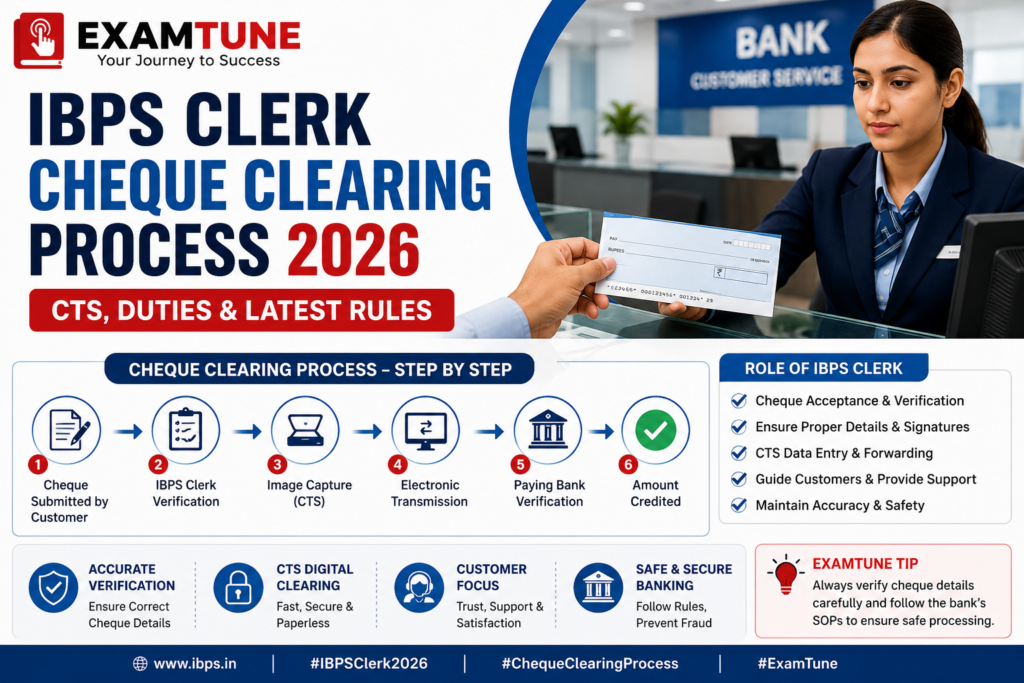
IBPS Clerk Cheque Clearing Process 2026 is an important branch-operations topic for candidates who want to understand current cheque collection, CTS processing, verification and customer-service duties. The Reserve Bank of India has moved the Cheque Truncation System (CTS) from traditional batch processing to continuous clearing with settlement on realisation. Phase 1 has been operational since 4 October 2025, while the tighter Phase 2 framework remains postponed until further notice.
The IBPS Clerk Cheque Clearing Process applies to normal branch operations and is not a separate Ex-Servicemen-specific procedure. An Ex-Serviceman selected through IBPS does not receive a special cheque-handling designation. After joining, duties are allocated by the respective Public Sector Bank according to branch requirements, internal controls, staff roles and the bank’s Standard Operating Procedures.
A Customer Service Associate may assist with cheque collection, preliminary scrutiny, data entry, customer guidance, inward/outward clearing support and related branch operations. However, final payment authorisation, signature verification, fraud checks and cheque passing may involve authorised officials and maker-checker controls depending on the bank’s internal system. Candidates should therefore avoid assuming that every clerk independently approves or rejects cheques.
IBPS Clerk Cheque Clearing Process 2026 Overview
| Particular | Current Details |
|---|---|
| Post | Customer Service Associate / Clerical Cadre |
| Applicable To | All appointed employees, including eligible Ex-Servicemen, as per duty allocation |
| Separate ESM Clearing Process | No |
| Cheque Clearing System | Cheque Truncation System (CTS) |
| Current Framework | Continuous Clearing with Settlement on Realisation – Phase 1 |
| Phase 1 Implemented | 4 October 2025 |
| Phase 2 | Postponed until further notice |
| Current Presentation Session | 9:00 AM to 3:00 PM |
| Current Confirmation Session | 9:00 AM to 7:00 PM |
| Cheque Validity | Generally 3 months from the date of the instrument |
| Regulator | Reserve Bank of India (RBI) |
Is Cheque Clearing a Special Duty for Ex-Servicemen?
No. Ex-Servicemen receive applicable recruitment benefits under IBPS rules, but after appointment they work under the same bank service framework as other employees in the same cadre. Cheque clearing is not an ESM-specific responsibility. A bank may assign an employee to cash, clearing, deposits, customer service, account-related work or another operational desk depending on staffing requirements and internal rotation.
ExamTune Note: It is safer to describe cheque clearing as a possible branch-operations responsibility of a Customer Service Associate rather than a compulsory or exclusive duty of every IBPS Clerk.
What Is Cheque Clearing?
In the IBPS Clerk Cheque Clearing Process, cheque clearing means that a cheque deposited by a customer is presented for collection and the amount is settled between the presenting bank and the drawee bank, subject to successful verification and payment. Under CTS, the physical cheque normally does not travel to the paying bank. Instead, the presenting bank captures the cheque image and relevant data and transmits them electronically through the clearing system.
The physical instrument remains with the presenting bank according to applicable retention and operational rules, while the drawee bank processes the electronic image and data for payment or return.
Latest CTS Cheque Clearing Rule in 2026
The current IBPS Clerk Cheque Clearing Process follows RBI’s Continuous Clearing and Settlement on Realisation framework to make cheque processing faster. Phase 1 started on 4 October 2025. Under the current framework, cheques are scanned and sent to the clearing house continuously during the presentation session instead of waiting for one traditional batch.
RBI had originally planned Phase 2 from 3 January 2026 with a tighter three-clear-hours confirmation window. However, on 24 December 2025, RBI postponed Phase 2 until further notice so that banks could further streamline their operations. The presentation and confirmation timings were also modified.
| CTS Stage | Current 2026 Position |
|---|---|
| Phase 1 | Implemented from 4 October 2025 |
| Presentation Session | 9:00 AM to 3:00 PM |
| Confirmation Session | 9:00 AM to 7:00 PM |
| Phase 2 / T+3 Clear Hours | Postponed until further notice |
| Processing Method | Continuous clearing with settlement on realisation |
IBPS Clerk Cheque Clearing Process: Step-by-Step Workflow
- Cheque Deposit: The customer deposits a cheque through the branch, cheque drop facility or another permitted collection channel.
- Preliminary Scrutiny: The collecting/presenting bank checks the instrument for visible completeness, date, payee details, crossing, material alteration and other applicable collection requirements.
- Cheque Capture: The presenting bank captures the MICR data and digital images of the cheque through its CTS-compatible capture system.
- Continuous Presentation: During the CTS presentation session, the bank sends cheque images and data to the clearing house continuously.
- Delivery to Drawee Bank: The clearing house makes the cheque image and relevant data available to the bank on which the cheque is drawn.
- Drawee Bank Processing: The paying bank carries out applicable system checks, mandate/signature verification, balance and account-status checks, Positive Pay matching where relevant, fraud controls and other internal validations.
- Positive or Negative Confirmation: The drawee bank confirms whether the cheque is honoured or returned under the applicable CTS process.
- Settlement: Settlement takes place according to the current continuous-clearing framework after successful confirmation/realisation.
- Customer Credit: The presenting bank credits the customer’s account according to the successful realisation and its cheque-collection process. RBI requires release of payment immediately after successful settlement and within one hour, subject to usual safeguards. This period starts from settlement, not from the customer’s deposit time.
IBPS Clerk Cheque Clearing Process: Role of a Clerk
The employee’s role in the IBPS Clerk Cheque Clearing Process varies from bank to bank. Depending on duty allocation and system permissions, a Customer Service Associate may support activities such as:
- Receiving cheques deposited by customers.
- Checking visible completeness of the cheque and deposit slip.
- Confirming that the cheque is presented through an appropriate collection channel.
- Entering or verifying collection-related data in the bank’s system.
- Supporting outward clearing and CTS scanning/capture processes.
- Assisting with inward clearing operations where authorised.
- Guiding customers about cheque collection or return status.
- Maintaining records and handling instruments according to the bank’s SOP.
- Escalating suspicious, altered or high-risk instruments to the authorised officer.
Important: The drawer’s signature is ultimately a payment-side check of the drawee bank. A collecting-branch employee should not be described as independently authenticating the drawer’s signature against records in every cheque-clearing transaction.
Cheque Verification Checklist for Branch Staff
| Verification Point | What to Check |
|---|---|
| Date | Cheque should not be stale and should not be processed before a future/post-dated date. |
| Validity | Cheques are generally valid for three months from the date written on the instrument. |
| Payee Name | Check that the payee information is legible and consistent with the collection request. |
| Amount | Check words and figures for apparent inconsistency or alteration; doubtful instruments should be handled as per bank rules. |
| Crossing | Check whether the cheque is crossed / account payee and collect it only in accordance with applicable rules. |
| Material Alteration | Look for overwriting, tampering or unauthorised changes and escalate where required. Under CTS, changes to the payee name or amount require a fresh cheque; the RBI exception for date validation does not permit other corrections. |
| Physical Condition | Ensure the instrument can be properly scanned and has not been materially damaged. |
| CTS Compatibility | Follow the bank’s procedure for CTS-compliant instruments and exceptions. |
| Positive Pay | For applicable large-value cheques, check the bank’s Positive Pay requirements/process. |
How Long Is a Cheque Valid in India?
Cheque validity is an important part of the IBPS Clerk Cheque Clearing Process. Under RBI directions, banks should not make payment of cheques, drafts, pay orders or banker’s cheques if they are presented beyond three months from the date of the instrument. Therefore, an old statement that a cheque is valid for six months should not be used in a 2026 article.
What Is Positive Pay System for Cheques?
Positive Pay is an important fraud-control concept in the IBPS Clerk Cheque Clearing Process. The Positive Pay System (PPS) is an additional fraud-control mechanism for cheque payments. The cheque issuer can provide key details such as cheque date, payee name and amount electronically to the drawee bank, and these details can be cross-checked when the cheque is presented through CTS.
RBI has advised banks to enable Positive Pay for account holders issuing cheques of ₹50,000 and above. Use of the facility is generally at the account holder’s discretion, while banks may consider making it mandatory for cheques of ₹5 lakh and above, depending on the bank’s policy.
NPCI provides the Positive Pay facility within CTS to participating banks. Customers submit their cheque details through the issuing bank’s supported channels, which may include SMS, mobile banking, internet banking or an ATM. Check the bank’s instructions before submitting the details.
Types of Cheques an IBPS Clerk May Encounter
| Cheque Type | Basic Meaning |
|---|---|
| Bearer Cheque | Payable according to the bearer instruction, subject to banking and identification controls. |
| Order Cheque | Payable to the person/entity named or as legally endorsed. |
| Crossed Cheque | Generally intended for collection through a bank account rather than over-the-counter cash payment. |
| Account Payee Cheque | Proceeds are to be collected for the payee named on the cheque, subject to applicable RBI rules. |
| Post-Dated Cheque | Should not be paid before the date written on the cheque. |
| Stale Cheque | A cheque presented beyond its permitted validity period. |
| Self Cheque | Normally used by an account holder for self-payment/withdrawal; it is not the standard inter-bank CTS collection example. |
Common Cheque Return Reasons
During the IBPS Clerk Cheque Clearing Process, a cheque may be returned for several reasons. The exact return reason/code is generated according to the bank and CTS rules. Common examples include:
- Insufficient funds.
- Signature differs / signature-related issue.
- Account closed, blocked or otherwise restricted.
- Payment stopped by the drawer.
- Cheque is stale or post-dated.
- Material alteration or suspected tampering.
- Incomplete or irregular instrument.
- Positive Pay-related discrepancy where applicable.
- Technical or image-quality issue requiring re-presentation, where permitted.
Account Payee Cheque Rule
An account payee cheque should ordinarily be collected for the account of the payee named on the cheque. RBI has directed banks not to credit the proceeds of an account payee cheque to the account of a person other than the payee, subject to specific permitted arrangements and exceptions under applicable rules.
IBPS Clerk Cheque Clearing Process: Safety Rules
- Follow the bank’s maker-checker and authorisation controls.
- Never alter customer-written cheque details yourself.
- Protect account information and maintain customer confidentiality.
- Escalate suspicious, tampered or unusual instruments to the authorised official.
- Use only authorised bank systems for cheque capture and processing.
- Follow Positive Pay and high-value cheque controls wherever applicable.
- Ensure physical instruments are stored and handled according to the bank’s retention procedure.
- Do not promise a customer that a cheque will definitely clear merely because it has been accepted for collection.
Customer Service Tips During Cheque Submission
- Explain that cheque deposit does not mean final payment has been received.
- Tell customers that actual credit depends on successful realisation.
- Guide customers about the bank’s branch cut-off time and collection policy.
- Provide an acknowledgement when a customer requests one while depositing a cheque at the branch collection counter.
- Explain return reasons only on the basis of the bank’s recorded information.
- For large-value cheques, guide customers about Positive Pay if required by the bank.
- Do not ask a customer to make unauthorised changes to an instrument.
- Refer disputed or suspicious cases to the authorised officer.
Benefits of Continuous CTS Clearing
- Faster presentation of cheque images.
- Reduced dependence on physical movement of instruments.
- Same-day processing in many normal clearing situations, subject to successful realisation and bank cut-offs.
- Improved operational efficiency.
- Electronic audit trail and image-based processing.
- Faster identification of honoured or returned instruments.
- Better integration with fraud controls such as Positive Pay.
ExamTune Tip: Do not memorise cheque clearing as “customer deposits cheque → clerk verifies signature → amount transfers.” In actual banking operations, cheque collection involves the presenting bank, CTS clearing infrastructure, drawee bank verification, settlement and bank-specific authorisation controls.
Important Difference: Collecting Bank vs Drawee Bank
| Bank Role | Main Function |
|---|---|
| Presenting / Collecting Bank | Receives the cheque for collection, captures cheque image/data and presents it through CTS. |
| Drawee / Paying Bank | The bank on which the cheque is drawn; performs payment-side verification and honours or returns the cheque. |
| Clearing System | Electronically routes cheque images/data and supports clearing and settlement between participating banks. |
IBPS Clerk Cheque Clearing Process: Does Every Clerk Handle It?
No. Not every employee handles the IBPS Clerk Cheque Clearing Process every day. The actual work profile depends on branch size, staff strength, internal rotation, system access and the duties assigned by the bank. A newly appointed CSA may work at customer service, deposits, clearing, cash-related support, account operations or another desk. Employees are expected to follow the bank’s internal training and SOP rather than rely only on general exam-preparation material.
Official RBI References for Cheque Clearing
- Reserve Bank of India – Official Website
- RBI Cheque Truncation System FAQs
- RBI Positive Pay System for CTS
- RBI Continuous Clearing Framework
- RBI Phase 2 Postponement and Revised Session Timings
Related IBPS Clerk Guides
- IBPS Clerk Ex Servicemen Posting & Transfer 2026
- IBPS Clerk Syllabus & Exam Pattern 2026
- IBPS Clerk Vacancy 2026
- IBPS Clerk Participating Banks 2026
IBPS Clerk Cheque Clearing Process 2026 – Final Summary
The IBPS Clerk Cheque Clearing Process 2026 should be understood as a bank-operational workflow rather than an Ex-Servicemen-specific duty. A CSA may support cheque collection and clearing activities according to the allotted bank’s internal procedures, while final payment decisions and controls are handled through authorised systems and officials.
In 2026, the key current rule is that CTS operates under continuous clearing with settlement on realisation under Phase 1. Phase 2, which was intended to introduce a tighter T+3 clear-hours confirmation window, remains postponed until further notice. Candidates should also remember the three-month cheque validity rule, Positive Pay framework for large-value cheques, and the difference between the presenting bank and the drawee bank.
Frequently Asked Questions
What is the cheque clearing process in IBPS Clerk?
The cheque clearing process is the procedure through which banks verify and process cheques before transferring funds to the beneficiary's account.
What is CTS in cheque clearing?
CTS (Cheque Truncation System) is an image-based cheque clearing system that speeds up cheque processing without physically moving cheques between banks.
What is inward cheque clearing?
Inward clearing refers to cheques received by a bank for payment from its own account holders after verification.
What is outward cheque clearing?
Outward clearing is the process of sending customers' deposited cheques to other banks for collection and payment.
Do IBPS Clerks handle cheque clearing work?
Yes, IBPS Clerks assist in cheque acceptance, verification, data entry, and supporting cheque clearing operations as per bank procedures.
Why is cheque verification important?
Cheque verification helps prevent fraud by checking signatures, account details, cheque validity, and other important information before payment.
What happens if a cheque is returned?
If a cheque fails verification or has insufficient funds or other issues, it may be returned according to banking rules.
Is cheque clearing included in IBPS Clerk training?
New employees learn the procedures needed for their assigned role under the employing bank’s training plan. Cheque handling, CTS and clearing support may be included where relevant. The content and timing are bank-specific; IBPS does not prescribe one practical cheque-clearing course for every recruit.
What banking software is used for cheque clearing?
Public Sector Banks use Core Banking Solutions (CBS) and cheque clearing modules integrated with CTS to process cheque transactions.
Why should Ex-Servicemen learn cheque clearing procedures?
Understanding cheque clearing helps Ex-Servicemen perform daily banking operations accurately, reduce errors, and provide better customer service.
About the Author

Practice free quizzes, mock tests, current affairs and exam-wise preparation resources on ExamTune.