
SBI Clerk Backlog Vacancy 2026: 7 Best Rules You Must Know
Quick Overview
Practice free quizzes, mock tests, current affairs and exam-wise preparation resources on ExamTune.
Download SBI Clerk Backlog Vacancy Official Notification PDF
Download the official SBI Junior Associate notification to check state-wise regular and backlog vacancies, category-wise seats, eligibility, local language requirements and selection details.

2026 Status Note: SBI has released the Junior Associate (Customer Support & Sales) recruitment for 2026-27 under Advertisement No. CRPD/CR/2026-27/17. Online registration and payment of fees are open from 11 August 2026 to 31 August 2026. The Preliminary Examination is tentatively scheduled for September 2026 and the Main Examination for November 2026. The official vacancy table shows 7,680 regular vacancies along with separately displayed backlog vacancies. Candidates should use this 2026-27 notification as the current official reference.
What Is SBI Clerk Backlog Vacancy 2026?
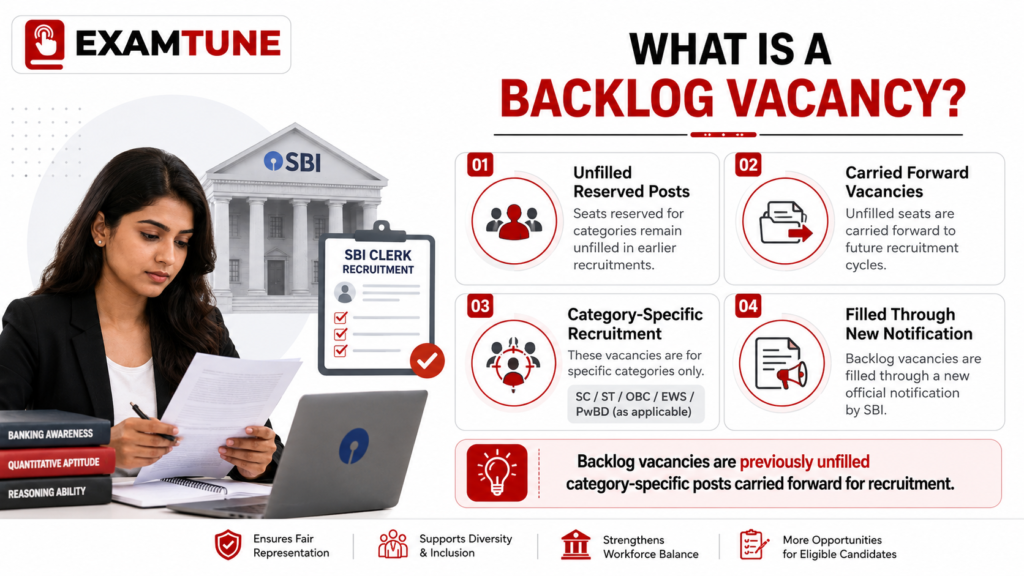
SBI Clerk Backlog Vacancy 2026 refers to reserved vacancies that remain unfilled from an earlier recruitment period and are shown separately by SBI when they are carried forward. These vacancies are not the same as the fresh or regular vacancies created for the current recruitment cycle.
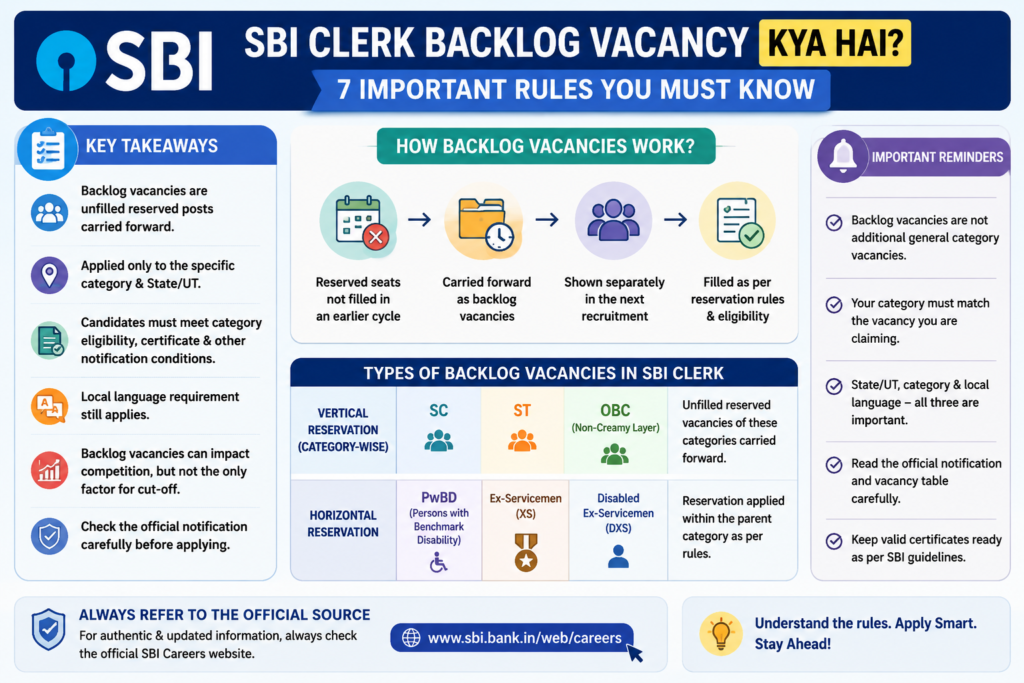
The official SBI Junior Associate 2026-27 notification displays two broad vacancy sections: Regular Vacancies and Backlog Vacancies. The backlog section separately shows vertical reserved-category vacancies for SC, ST and OBC, along with backlog figures for horizontal reservation categories such as PwBD and Ex-Servicemen/Disabled Ex-Servicemen.
This means a candidate should never look only at the overall number printed in a State row. The correct approach is to identify the State/UT, the relevant category column, the local language requirement, and whether the number belongs to a regular or backlog section.
Regular Vacancy vs Backlog Vacancy in SBI Clerk
| Point | Regular Vacancy | Backlog Vacancy |
|---|---|---|
| Meaning | Fresh vacancies notified for the current recruitment cycle. | Reserved vacancies carried forward because they remained unfilled earlier, subject to applicable rules. |
| Display in Notification | Shown under the regular vacancy section. | Shown separately under the backlog vacancy section when applicable. |
| Category Relevance | Available according to the category-wise distribution shown by SBI. | Relevant only to the specific reserved category or horizontal reservation group shown in the table. |
| State/UT Link | State/UT specific. | Also State/UT and category specific. |
| Can General Candidates Claim It? | General candidates compete for seats applicable to their category. | Not automatically. A backlog seat must be read according to the category for which SBI has notified it. |
7 Important Rules for SBI Clerk Backlog Vacancy 2026
Rule 1: Backlog Vacancies Are Not Fresh General Vacancies
The first rule of SBI Clerk Backlog Vacancy 2026 is that backlog seats should not be treated as extra open-category seats. Their purpose is connected with previously unfilled reserved vacancies. If a vacancy is shown under an SC, ST, OBC, Pw BD, XS or DXS backlog column, its treatment is governed by the reservation framework and the category shown in the official advertisement.
Therefore, a General-category candidate should not add every backlog number to the General vacancy total. Similarly, an EWS candidate should not assume that a backlog vacancy shown under another reserved category becomes available merely because it is present in the same State.
Rule 2: Your Category Must Match the Vacancy You Are Claiming
While reading SBI Clerk Backlog Vacancy 2026, candidates must check whether a backlog vacancy exists for their own eligible category in the chosen State/UT. SBI requires category claims and certificates to follow the conditions given in the notification.
The official Junior Associate 2026-27 notification states that OBC candidates seeking reservation must belong to the Non-Creamy Layer. Candidates belonging to the creamy layer are not entitled to OBC reservation and should indicate their category as General or General (LD/VI/HI/d&e), as applicable. The OBC certificate must be in the Government of India prescribed format with the Non-Creamy Layer clause and should be issued during the period 01.04.2026 to the date of taking up appointment, if selected. EWS and other reserved-category claims are also subject to the prescribed certificate and verification rules.
In short, the presence of a backlog number does not create eligibility by itself. Your category status, documents and notification conditions must support the claim.
Rule 3: Backlog Vacancies Are State/UT Specific
SBI Clerk Backlog Vacancy 2026 must always be read State-wise. SBI Junior Associate recruitment is not one common all-India vacancy pool for final allotment. Under Advertisement No. CRPD/CR/2026-27/17, candidates can apply for vacancies in only one State/UT and can appear for the test only once under this recruitment project. Candidature is considered only against the State/UT selected in the application.
This is especially important because one State may have a substantial backlog in a category while another State may show zero backlog for the same category. Choosing a State only after looking at backlog numbers is also risky because local language requirements, category eligibility, competition level and posting rules must be considered together.
SBI also states that the merit list is drawn State-wise and category-wise. Therefore, vacancy analysis should always be done within your chosen State/UT and eligible category.
Rule 4: Local Language Requirement Still Applies
A backlog vacancy does not remove the local language condition. Candidates targeting SBI Clerk Backlog Vacancy 2026 must still satisfy the specified local language requirement for the State/UT they apply for.
In the SBI Junior Associate 2026-27 notification, candidates are required to be proficient in reading, writing, speaking and understanding the specified opted local language. Candidates who produce a Class 10 or Class 12 mark sheet/certificate showing that they studied the specified opted local language are not required to undergo the language test. For other provisionally selected candidates, the Local Language Proficiency Test is conducted before joining, and failure to qualify results in disqualification from appointment.
So, even if a State appears attractive because of backlog vacancies, you should not choose it without checking the language requirement first.
Rule 5: Do Not Add Vertical and Horizontal Backlog Totals Blindly
This is one of the most important technical points about SBI Clerk Backlog Vacancy 2026. In the latest official vacancy table, backlog vacancies were shown under SC/ST/OBC and also under PwBD and XS/DXS columns. However, SBI specifically states that reservation for PwBD, XS and DXS candidates is horizontal reservation and is included in vacancies of the parent categories.
That means you should not simply add every backlog subtotal and announce the result as a unique number of additional seats. In the 2026-27 official table, the SC/ST/OBC backlog subtotal is 287 (SC 58, ST 161, OBC 68), the PwBD backlog subtotal is 355 (VI 76, HI 113, LD 80, d&e 86), and the XS/DXS backlog subtotal is 1,444 (XS 964, DXS 480). SBI also states that these backlog vacancies are net of the vacancies advertised in the Special Recruitment Drive under Advertisement No. CRPD/CR/SPLDRIVE/2026-27/16 for SC/ST/OBC candidates, State-wise/Category-wise.
Because PwBD, XS and DXS reservations are horizontal and are included in the vacancies of parent categories, adding 287 + 355 + 1,444 and calling the result the total number of distinct backlog posts would be misleading.
For accurate vacancy analysis, read each reservation block exactly as SBI presents it.
Rule 6: Backlog Vacancy Can Influence Competition, but It Does Not Guarantee a Lower Cut-Off
Many aspirants believe that a higher SBI Clerk Backlog Vacancy 2026 number automatically means an easy selection or a very low cut-off. This is not a safe conclusion. Vacancy count is only one factor that can influence competition.
Actual selection pressure may also depend on the number of applicants, category-wise performance, exam difficulty, State-wise merit and the number of candidates satisfying all eligibility and language requirements. SBI does not promise a particular cut-off merely because backlog vacancies exist.
A better strategy is to treat backlog vacancies as part of your vacancy analysis, not as a shortcut to selection.
Rule 7: Vacancies Are Provisional and the Official Notification Is Final
The final rule for SBI Clerk Backlog Vacancy 2026 is to avoid relying on unofficial vacancy graphics without checking SBI’s notification. SBI clearly states in its latest Junior Associate advertisement that the announced vacancies are provisional and may vary depending on the Bank’s actual requirement.
This also means a coaching post, social media table or old-year vacancy chart should not be treated as final proof. Always check the official advertisement, corrigendum, result notice and SBI Careers updates for the recruitment cycle you are applying for.
Latest Official Backlog Structure: What Candidates Should Learn
For candidates researching SBI Clerk Backlog Vacancy 2026, the official Junior Associate 2026-27 vacancy table provides several useful lessons. It shows 7,680 regular vacancies across the listed States/UTs: SC 1,114, ST 837, OBC 1,716, EWS 760 and GEN 3,253. In the backlog section, SBI separately displays 287 SC/ST/OBC backlog vacancies, 355 PwBD backlog vacancies and 1,444 XS/DXS backlog vacancies. Since PwBD, XS and DXS are horizontal reservations included in parent categories, these subtotals should not be added together as distinct additional posts.
The State-wise pattern was highly uneven. Some States had zero backlog in the vertical SC/ST/OBC section, while others had notable carried-forward vacancies. This is why a single national-level backlog number does not tell a candidate how many relevant seats are available in his or her State and category.
The table also demonstrates that backlog vacancy analysis requires three separate checks: State/UT, eligible category, and reservation type. Candidates should especially distinguish vertical reservations such as SC/ST/OBC from horizontal reservations such as PwBD and Ex-Servicemen categories.
Does SBI Clerk Backlog Vacancy 2026 Benefit General Category Candidates?
For most candidates, this is the biggest question. SBI Clerk Backlog Vacancy 2026 should not be interpreted as a direct increase in General-category vacancies unless SBI’s official table and applicable rules specifically provide such treatment.
If backlog posts are shown for SC, ST or OBC categories, a General candidate cannot simply count them as General seats. The same principle applies to other reserved groups. General candidates should focus on the General vacancies shown in the relevant State/UT and should not calculate their opportunity by adding reserved backlog columns.
However, backlog vacancies can still affect the overall recruitment picture because they change the category-wise distribution of available posts. Their effect on competition should therefore be analysed carefully, not exaggerated.
How to Read the SBI Clerk Backlog Vacancy Table Correctly
- Find your State/UT in the official SBI Junior Associate vacancy table.
- Check the local language listed for that State/UT.
- Read the regular vacancies for your category.
- Move to the backlog section and check only the category or horizontal reservation group relevant to you.
- Do not merge SC/ST/OBC backlog numbers with Pw BD or XS/DXS totals without understanding horizontal reservation.
- Check the notification notes below the vacancy table.
- Confirm category certificates, age relaxation and other eligibility conditions.
- Re-check SBI Careers for corrigenda, updated vacancy information and result or wait-list notices.
Following this method will help you understand SBI Clerk Backlog Vacancy 2026 without misreading the vacancy matrix.
Common Mistakes Candidates Make
- Adding every backlog column together: This may double-count horizontal reservation positions.
- Assuming backlog means extra General seats: Backlog vacancies are tied to the notified reservation category.
- Ignoring the State/UT: SBI Clerk vacancies and merit are State/UT based.
- Choosing a State only for higher vacancy: Local language and posting restrictions also matter.
- Using an old vacancy chart: Vacancy distribution can change from one recruitment cycle to another.
- Ignoring certificate rules: Reserved-category benefits depend on valid eligibility and documents.
Is Backlog Vacancy Different from SBI Clerk Wait List?
Yes. SBI Clerk Backlog Vacancy 2026 and a wait list are two different concepts. Backlog vacancy refers to the vacancy structure itself, generally involving reserved posts carried forward from an earlier period.
A wait list, on the other hand, is related to candidates who may be provisionally selected later against non-joining or other vacancies under the conditions of that recruitment process.
For the 2026-27 recruitment, SBI states that a wait list of up to 50% of vacancies, State-category wise, will be maintained. Candidates may be released from this wait list on a quarterly basis against non-joining and resignation from the current batch, subject to the Bank’s qualifying conditions, and the wait list will remain valid for one year from the date of declaration of the final result. This wait list is still different from the backlog columns shown in the vacancy table.
Why SBI Clerk Backlog Vacancy 2026 Matters for Your Preparation
Understanding SBI Clerk Backlog Vacancy 2026 can help you make a more realistic assessment of your recruitment opportunity. Vacancy analysis is useful, but it should never replace exam preparation.
A State with more relevant vacancies may appear favourable, but strong competition can still produce a demanding cut-off. Similarly, a State with fewer vacancies does not automatically become impossible. Your score in the examination remains one of the most important factors.
Use vacancy data to understand the recruitment structure and then focus on building speed, accuracy, mock-test performance and a strong Mains score.
Important Points for General Category Candidates
If you belong to the General category and are analysing SBI Clerk Backlog Vacancy 2026, remember these points:
- Do not add SC, ST or OBC backlog seats to the General vacancy count.
- Check the General vacancies shown under regular vacancies for your State/UT.
- Do not assume that a high total backlog automatically improves the General-category selection probability.
- Compare State-wise competition only after checking eligibility and local language rules.
- Use the final SBI notification rather than unofficial vacancy predictions.
Final Conclusion
SBI Clerk Backlog Vacancy 2026 is best understood as a category-specific and State/UT-specific carried-forward vacancy concept rather than a pool of extra seats available to all candidates.
The most important points are to separate regular and backlog vacancies, check your eligible category, understand horizontal reservation, verify the local language requirement, and avoid adding different reservation columns blindly.
Because SBI states that vacancies are provisional, candidates should use the current 2026-27 Junior Associate advertisement, CRPD/CR/2026-27/17, as the final authority for this recruitment cycle. Check its State-wise and category-wise vacancy table, local-language requirement and SBI Careers updates before finalising your application strategy.
Related SBI Clerk Guides
If you are checking SBI Clerk Posting rules, you should also understand the latest notification, eligibility conditions and State-wise vacancies before choosing your State/UT. Explore these important SBI Clerk guides on ExamTune:
1. SBI Clerk Notification 2026:
Check recruitment updates, selection process, exam pattern, important dates and application rules.
Read SBI Clerk Notification →
2. SBI Clerk Eligibility Criteria:
Check age limit, educational qualification, nationality and local-language requirements before applying.
Check SBI Clerk Eligibility →
3. SBI Clerk Vacancy:
Check State-wise and category-wise SBI Clerk vacancies before deciding your preferred State/UT.
Check SBI Clerk Vacancy →
ExamTune Tip: Before selecting a State for SBI Clerk, compare the vacancy, local-language requirement, eligibility conditions and SBI Clerk Posting rules together. A higher vacancy count alone should not decide your State preference.
SBI Current Openings – Junior Associates 2026, Advertisement No. CRPD/CR/2026-27/17
Previous SBI Junior Associate Detailed Advertisement (archive reference)
Frequently Asked Questions
What is SBI Clerk Backlog Vacancy 2026?
SBI Clerk backlog vacancies are generally reserved-category posts that remained unfilled in an earlier recruitment cycle and are carried forward for recruitment according to applicable reservation rules.
SBI Clerk Backlog Vacancy Kya Hai in simple words?
In simple words, a backlog vacancy is a previously unfilled reserved post that SBI may show separately from fresh or regular vacancies in the official vacancy table.
Can General category candidates apply for SBI Clerk backlog vacancies?
General-category candidates cannot automatically claim backlog vacancies notified for SC, ST, OBC or another reserved category. Candidates must check the category specified against each vacancy in the official notification
Are SBI Clerk backlog vacancies State-wise?
Yes. SBI Clerk vacancies are generally State/UT specific. Candidates should check the backlog vacancies available for their selected State/UT and their eligible category
Is a backlog vacancy different from a regular SBI Clerk vacancy?
Yes. Regular vacancies are announced for the current recruitment cycle, while backlog vacancies generally represent eligible reserved posts carried forward from previous recruitment periods.
Does the local language requirement apply to SBI Clerk backlog vacancies?
Yes. Applying against a backlog vacancy does not normally remove the specified local language requirement. Candidates must satisfy the language conditions prescribed for their chosen State/UT
Can SBI Clerk backlog vacancies reduce the cut-off?
A higher number of relevant vacancies may influence competition, but it does not guarantee a lower cut-off. Applicant numbers, exam difficulty, category-wise performance and State-wise merit also affect selection.
Are PwBD and Ex-Servicemen backlog vacancies counted separately?
Candidates should read these figures carefully because PwBD and Ex-Servicemen reservations can operate as horizontal reservations within parent categories. Therefore, different backlog columns should not be added blindly.
Is SBI Clerk backlog vacancy the same as the wait list?
No. A backlog vacancy relates to the vacancy structure and previously unfilled reserved posts, whereas a wait list contains candidates who may be considered later under the conditions of the same recruitment process.
Where should I check official SBI Clerk backlog vacancies?
Candidates should verify backlog and regular vacancy details only through the official SBI Careers recruitment notification and vacancy table. SBI may also issue corrigenda or subsequent recruitment updates.
Practice free quizzes, mock tests, current affairs and exam-wise preparation resources on ExamTune.